Cluj's ban on Russian symbols: the right call amid Olympic evasion
The decision by Cluj's mayor to ban Russian symbols at a major gymnastics event has drawn both condemnation from Moscow and praise within Romania. The move is seen as a stand against normalizing Russian state symbols during the ongoing war in Ukraine. The article critiques the notion that sports can remain apolitical, citing past incidents where Russian athletes displayed pro-war symbols.

The Russian Embassy announced that its athletes would not attend the Rhythmic Gymnastics World Challenge Cup in Cluj after Mayor Emil Boc barred the Russian flag and anthem from the event. Moscow's officials condemned the decision. Many in Romania praised it as a necessary stand against normalizing a belligerent state's symbols inside the European Union. Romania, and Cluj in particular, should not provide a platform for Russian state symbolism while the war against Ukraine continues.
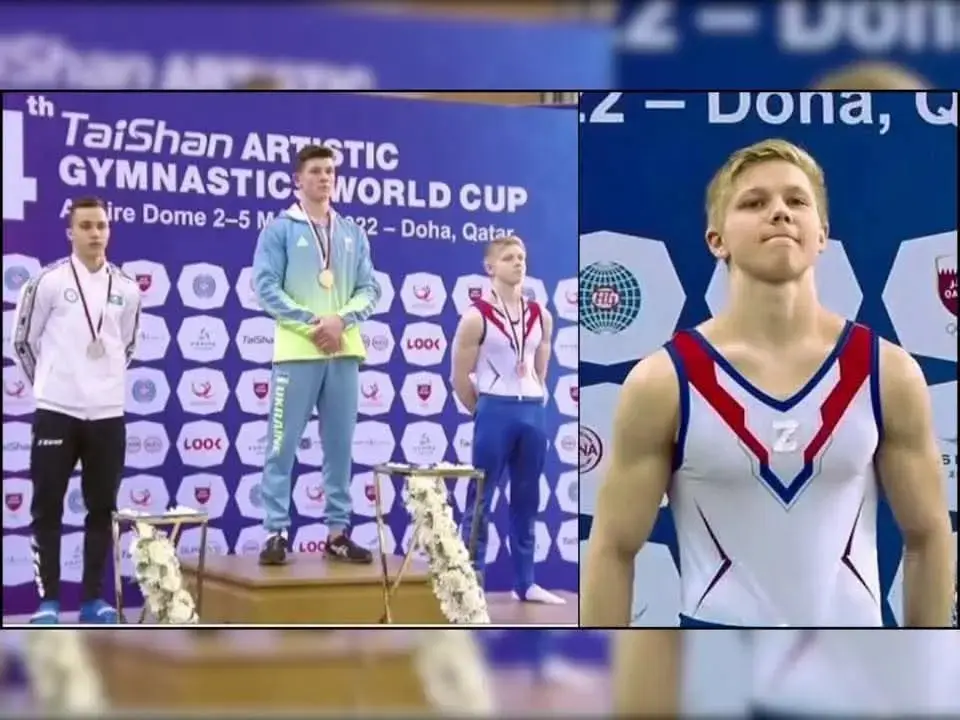
International sports administrators treat athletes as if they exist outside politics, as if competition insulates them from their governments' actions. The facts do not support this fiction. Ivan Kuliak, the Russian gymnast who wore the "Z" symbol on his uniform at the Doha World Cup in March 2022, is instructive. Days after the invasion began, he stood on the podium next to Ukrainian gold medalist Illia Kovtun, displaying the "Z" on his chest. The International Gymnastics Federation (FIG) responded with a one-year suspension, stripped him of his bronze medal, ordered the return of his 500 Swiss franc prize, and fined him 2,000 Swiss francs for procedural costs. His appeal was rejected.
The "Z" is not an innocent letter. It is a symbol painted on tanks rolling into Ukrainian cities. When an athlete chooses to display it on the world stage, the boundary between sport and politics collapses. The International Gymnastics Federation recognized this in Kuliak's case. Yet with each subsequent decision to readmit Russian athletes and symbols, the line blurs again.
Boc's intervention was both prompt and unequivocal. In his statement, made while attending a climate action forum in London, he insisted that the BTarena in Cluj-Napoca would not host the Russian flag or anthem during the competition scheduled for June 26-28. "This decision is not a protest against athletes, I have nothing against sport, I support sport, but I do not agree that the political symbols of an aggressor state in Europe should be used in a European Union country, in Cluj, a country that has so often expressed its position against Russia's aggression towards Ukraine," Boc told reporters. He called on both the Romanian Gymnastics Federation and Romanian authorities to clarify the situation before the event.
Reaction from Moscow was swift. Dmitri Svișcev, first deputy chair of the Committee for Physical Culture and Sport in the Russian State Duma, told TASS that Romania should be stripped of the right to host international tournaments because of Boc's stance. Svișcev described the move as a "violation of the organizer's obligations for international competitions." He threatened that, unless reversed, both the International Federation and the International Olympic Committee should sanction the organizers. He pointed to precedents where countries have lost the right to host competitions for excluding Russian athletes, warning that Romania faced the same scenario.
Valentina Rodionenko, a prominent Russian coach with credentials dating back to the Soviet era, added her own commentary. She suggested that Boc should focus on running his city rather than engaging in politics, and expressed surprise that, after international and European gymnastics federations had lifted all restrictions on Russian athletes, such incidents could still occur.
The Russian Embassy in Bucharest then announced it would withdraw its athletes from the Cluj event entirely. For some, this outcome might seem like a victory for Russian intransigence. In reality, it is the opposite: when faced with a principled refusal to display their symbols, the Russian authorities chose to take their athletes home rather than compete on neutral terms.
The strongest objection to Boc's position is not new. Athletes should not be punished for the actions of their governments, the argument goes. The image of the "innocent child who only loves sport" is invoked, as if athletes are entirely distinct from the societies and systems that produce them. This argument has emotional appeal. In some cases there is truth to it, many athletes have no say in their government's policies, and some have even risked their careers to protest them. But the Kuliak case, and the Russian state's orchestrated response to Boc's decision, show that the line is rarely so clear.
International sport is not, and never has been, a politics-free zone. The Olympic Charter itself is full of high-minded language about peace and friendship. But the Games have always been an arena for national rivalry and, at times, state propaganda. When Russian athletes compete under the flag and anthem of the Russian Federation, at a time when that state is waging war on its neighbor, the symbolism is not lost on anyone. The International Gymnastics Federation's decision to permit those symbols again, after initially barring them, is a concession to the same logic that has long allowed authoritarian states to launder their reputations through sport.
Boc's decision did not ban Russian athletes from competing in Cluj. He did not call for their exclusion from the event, only for the prohibition of state symbols, flag, anthem, and the like. This distinction matters. Allowing athletes to compete as individuals, without the trappings of state power, preserves the essence of competition while denying the aggressor state the propaganda victory it seeks. The Russian response, to withdraw entirely, demonstrates that for Moscow, the symbols are the point. The same €2,000 penalty imposed on Kuliak for his conduct is trivial compared to the symbolic value the Russian state sees in the display of its flag and anthem abroad.
The episode also exposes the limits of international federations' willingness to uphold their own sanctions. The FIG initially barred Russian symbols, then reversed itself and allowed them again, even as the war in Ukraine drags on. Boc's demand that the Federation adhere to the rules in place when Cluj was awarded the competition is not unreasonable. Organizers in a European Union country, with a government that has condemned Russian aggression, have a right (indeed, a duty) to refuse to host the symbols of that aggression.
Some will argue that Boc's stance is a political gesture, aimed at boosting his own popularity at home. Svișcev, the Russian parliamentarian, called it a "PR action." Politicians sometimes use sporting controversies for their own ends. Yet the fact remains that the Cluj mayor's position is in line with the Romanian government's repeated condemnation of the war, and with the official stance of the European Union. The charge of political opportunism is not a rebuttal to the substantive argument: that hosting Russian symbols at a time of war is itself a political act, and one that Romania is right to reject.
From the perspective of the athletes themselves, the situation is not without precedent. Russian teams have competed under neutral flags at various international events since the start of the war, and before that due to doping sanctions. The world has not ended. Athletes have still won medals. The difference, in Cluj's case, is that the Russian side refused to accept even this limited compromise.
The consequences of Boc's decision, and the Russian withdrawal, will likely be felt most by the young athletes who miss a chance to compete. Yet the responsibility for this outcome lies not with the Cluj mayor, nor with Romanian authorities, but with the Russian state that insists on making sport a theater for its political ambitions. The demand for flag and anthem is not about the athletes' rights. It is about the projection of state power.
For the international sports establishment, the Cluj episode should serve as a warning. The attempt to separate sport from politics fails when the state uses its athletes as instruments of propaganda. The International Gymnastics Federation's wavering posture, first banning, then allowing, Russian symbols, only invites further politicization, not less. When faced with a choice between upholding the values of fair play and caving to the demands of an aggressor state, federations too often choose expedience.
Boc's call for both the Romanian Gymnastics Federation and national authorities to clarify the rules before the event was not just bureaucratic caution. It was a recognition that, in the absence of clear standards, organizers are left to improvise under pressure from all sides. The risk of disputes or even disruption during the event is real, as seen in other contexts where the presence of Russian athletes has provoked protest or boycott.
Some will say that excluding Russian athletes, or their symbols, undermines the universality of sport. But universality does not mean moral blindness. The Olympic movement, for all its faults, has at times recognized this, most notably when South Africa was excluded during apartheid. The bar for exclusion should be high, and applied consistently. But when a state invades its neighbor and seeks to use sport to whitewash its actions, a line must be drawn.
The episode in Cluj is not an isolated incident. It is part of a wider pattern, visible in international football, tennis, and other sports, where the question of Russian participation has become a proxy for the international community's willingness to confront aggression. The pressure to "keep politics out of sport" is, in effect, a demand to ignore the obvious: that sport is already political, and always has been.
For Romanian sport, the stakes are not merely symbolic. Hosting international competitions is a point of pride, and the threat of losing that privilege is real. Yet the cost of acquiescing to Russian demands would be higher. It would signal that, in the face of aggression, the only thing that matters is the smooth running of events, not the values those events are supposed to represent.
It is tempting to believe that compromise is possible, that a middle ground can be found where Russian athletes compete, the flag and anthem are absent, and everyone goes home satisfied. In practice, the Russian state has shown it is not interested in such arrangements. The withdrawal from Cluj is proof enough.
The Romanian authorities, for their part, have so far backed Boc's position, at least implicitly. The government has consistently condemned the war in Ukraine, and Romania has provided support to Ukrainian refugees and the Kyiv government. To allow Russian state symbols in a major sporting event, on Romanian soil, would be a profound contradiction of that stance.
The broader lesson is that rules and principles matter. When the International Gymnastics Federation changed its policy to allow Russian symbols, it created confusion for organizers and athletes alike. Boc's insistence on upholding the original terms under which Cluj was awarded the competition is not only defensible. It is necessary for the integrity of the event.
There is a certain irony in the Russian demand that Romania be punished for refusing to display the symbols of an invading state. The same logic would have seen apartheid South Africa welcomed back to sport in the 1980s, or any other pariah regime granted the honor of international recognition. The principle at stake is not anti-Russian sentiment, but the refusal to legitimize aggression through ceremony.
The Cluj episode will not end the debate over Russian participation in international sport. Nor will it prevent future attempts by the Russian state to use athletes and competitions as instruments of soft power. But it does set a precedent, one that other cities and organizers would do well to follow. The cost of principle is sometimes high. The cost of its absence is higher still.
In the end, the withdrawal of Russian athletes from Cluj is the logical outcome of a standoff in which one side insists on the right to promote its symbols, and the other refuses to be complicit. For Romania, and for Cluj, the message is simple: there are some lines that should not be crossed. The war in Ukraine is not a distant conflict. It is a test of Europe's resolve and values. In refusing to allow the symbols of aggression to fly in its arenas, Cluj has chosen rightly.
The International Gymnastics Federation, and other sports bodies, must decide whether they will stand with those who uphold the values of sport, or with those who seek to subvert them for political ends. The answer, in Cluj at least, is unambiguous.
Comentarii
Fii primul care comentează.
CIA chief travels to Moscow following US intelligence on Russian military preparations
Macron refutes CIA warning, strengthens defense in Saudi Arabia
AUR's calculated reversal: Simion seeks recognition, not margins
