Fear in Childhood – the Invisible Wound That Can Accompany a Person for Life
Children who grow up in fear - of criticism, punishment, or conditional love - carry invisible wounds that shape their sense of self and safety. This essay explores how chronic fear develops, how it manifests in behavior, and what parents can do to create environments where children feel secure enough to learn, make mistakes, and build their own paths with courage.

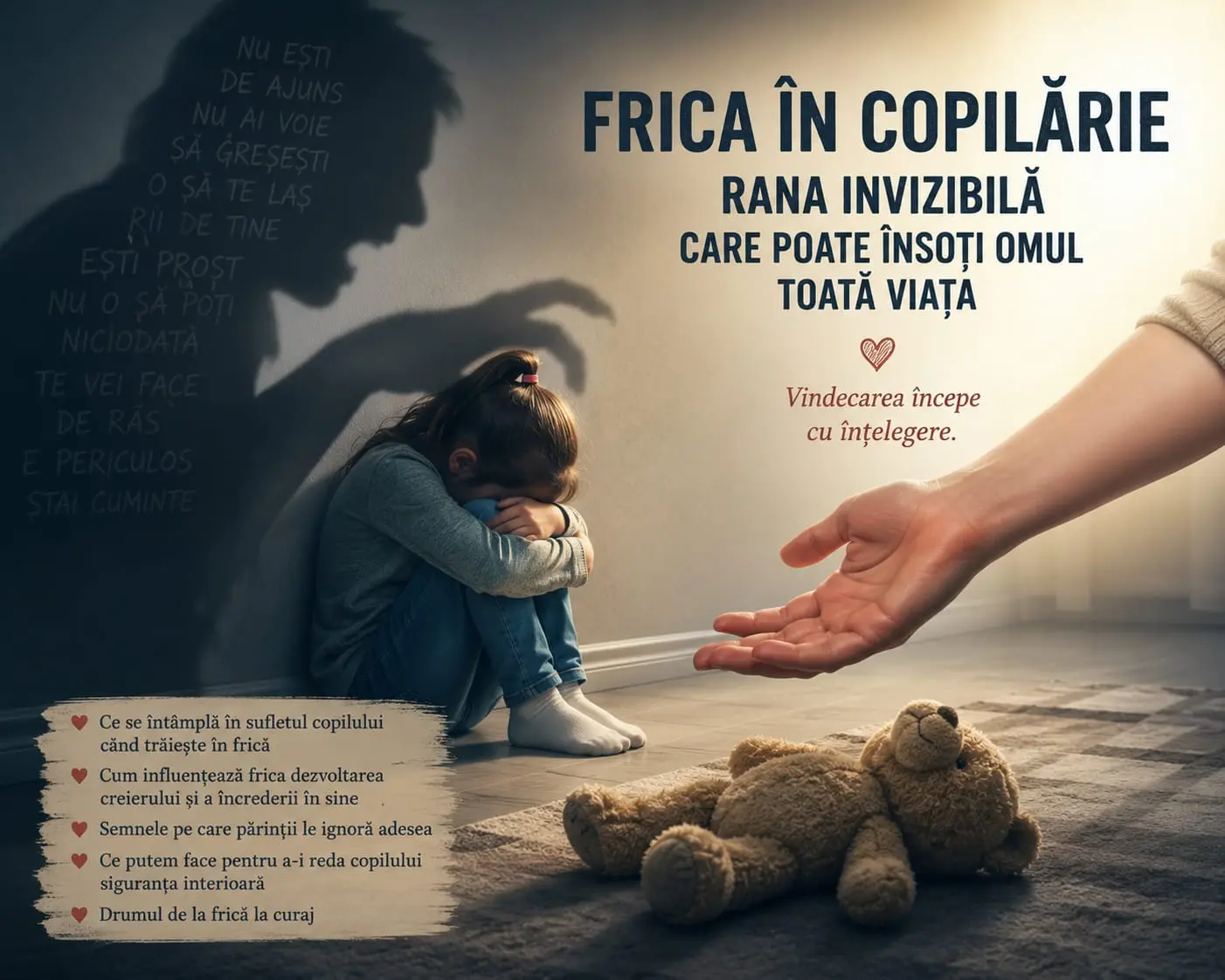
One evening, a six-year-old boy accidentally spilled a glass of milk. He wasn't crying because he got wet. He was crying before the parent said a single word. He covered his head with his hands and repeated: "I'm sorry… don't scold me…" For an adult, it was an accident. For that child, a fear he had already learned had been activated: mistake means danger.
Fear doesn't always leave bruises. Often it cannot be photographed and doesn't show up in medical tests. Yet it can shape the way a child thinks, loves, learns and sees himself.
What is fear and when does it become a problem
Fear is a natural emotion and has the role of protecting us. Children may be afraid of the dark, loud noises or strangers, and these fears are part of normal development. The problem appears when fear becomes the usual way the child lives: he is afraid to speak, to make mistakes, to express his emotions or to be himself.
How fear is born
Rarely are children born fearing their own worth. Most often, fear appears from repeated experiences: constant criticism, humiliation, comparisons, verbal or physical violence, threats, instability in the family, lack of predictability or a climate in which love seems conditioned on performance. Even overprotection can transmit the message that the world is too dangerous and that he is not capable enough.
What science says
Research in developmental psychology and neuroscience shows that repeated exposure to intense stress can influence the development of systems involved in emotional regulation and learning. A child who lives permanently on alert consumes his energy trying to feel safe, not exploring and learning. Therefore, emotional safety is a condition of healthy development, not an indulgence.


How we recognize a child who lives in fear
Sometimes he becomes very well-behaved and doesn't bother anyone. Other times, he is aggressive, avoids eye contact, lies out of fear, has stomach aches before school, doesn't sleep well or gives up easily on challenges. Behind these behaviors there may exist an unspoken question: "Am I safe?"
What parents can do
The child needs to know that he is loved even when he makes mistakes. Criticism can be replaced with guidance, and humiliating punishment with the establishment of firm and respectful boundaries. Listen before you judge. Ask: "What happened?" before "Why did you do that?". Validate the emotion, even if you don't agree with the behavior.
Five things worth doing
• Speak calmly, even when you are upset.
• Avoid comparisons with other children.
• Praise the courage to try, not just success.
• Offer routines and predictability.
• Ask for specialist help if you notice that fear is affecting his daily life.
A message for every parent
Children won't remember years later all the toys they received. They will remember, however, how they felt in our presence. If at home they felt fear, they will always seek the approval of others. If they felt safety, they will have the courage to build their own path.
Conclusion
Perhaps the greatest inheritance we can leave a child is not a house, a diploma or a bank account. Perhaps it is the deep conviction that his worth doesn't depend on perfection and that, no matter how many times he will fall in life, there exists a place where he will be received with understanding. A child raised in safety won't be without fears, but he will learn that he doesn't have to face them alone. And this is one of the most important lessons he can receive.
Comentarii
Fii primul care comentează.