When three airports fail, a newsroom builds what they should have
Transilvania Times introduces a unified, bilingual flight board for Cluj, Târgu Mureș, and Sibiu airports, updating every ten minutes and accessible on any device. This tool bridges the gap left by official airport websites, providing live status, gate, and check-in information in a single, user-friendly interface. Passengers and those waiting can now easily track flights across the region.

Imagine generată cu inteligență artificialăA Q
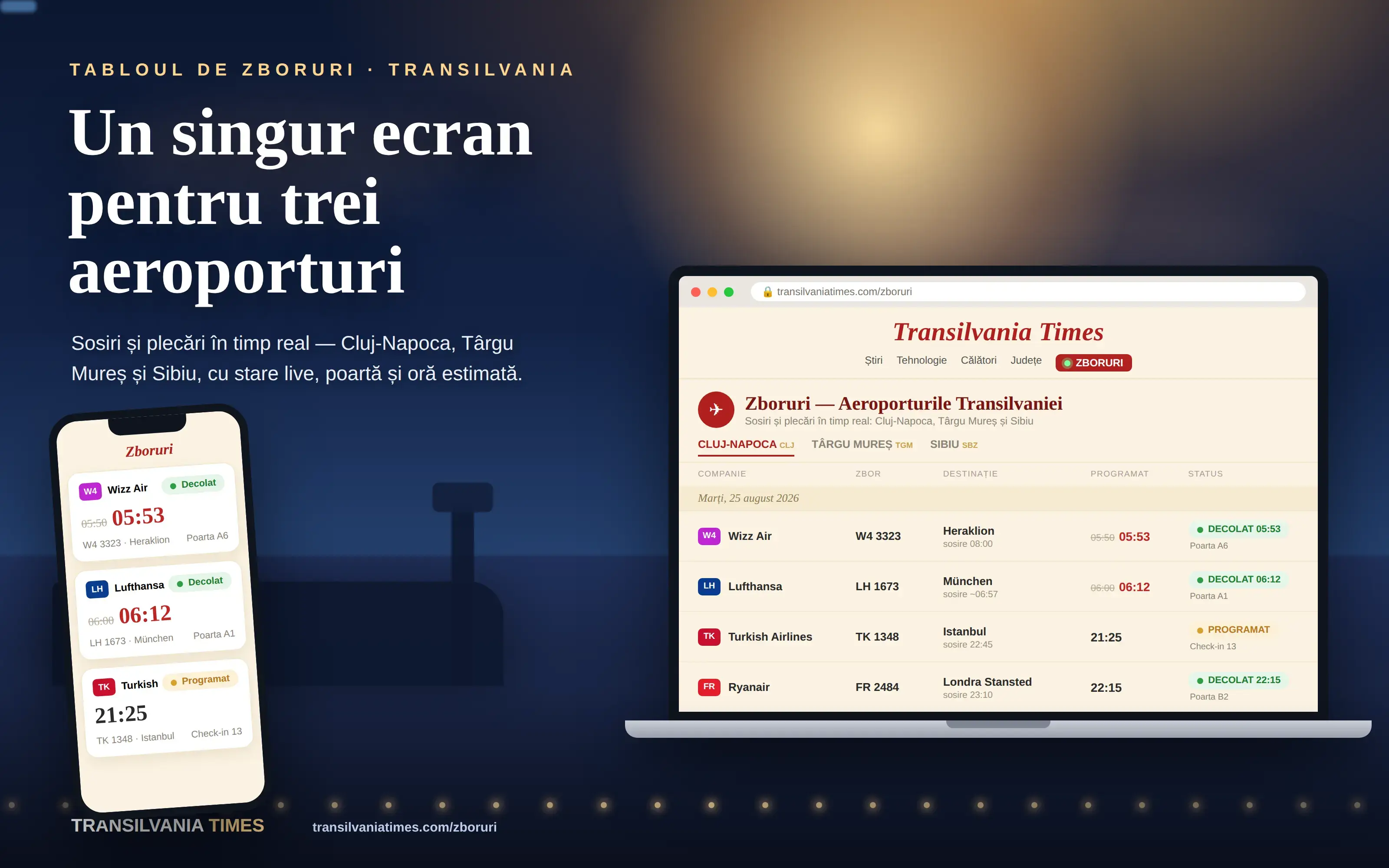
A single real-time flight board for Cluj, Târgu Mureș and Sibiu ends the era of juggling three separate airport websites. Transilvania Times has launched a bilingual flight panel that updates every ten minutes, free to use, accessible from any phone. Until now, anyone tracking an arrival in Transylvania faced a choice between incomplete schedules, missing gate information, and websites that refused to speak to one another.
The gap between what passengers need and what airports provide has been glaring. The new tool gathers departures and arrivals for all three airports in one place. The result is a living map of the region's sky rather than a static relic of a printed timetable.
For Cluj, which handles the largest volume of flights in the region, the official airport website offers only scheduled times. No live status. No gate number. No check-in desk. No real estimate if a flight is delayed or if a gate has changed. The Transilvania Times flight board, built with the airport's approval, draws directly from the internal display system in the terminal. The same "Departed 06:02", "Gate A7", "Check-in 13" information that travelers see on the ground now appears on the phone of anyone waiting outside, or indeed, anywhere in the world.
For Târgu Mureș and Sibiu, the tool scrapes what the airports themselves publish but presents it in a unified, clean format. Previously, a passenger or driver had to parse three differently styled tables, sometimes with contradictory labels or missing data. Now, a single screen shows the same flight status logic for all three: Scheduled, Check-in Open, Gate Open, Boarding, Departed, Landed, Delayed, Cancelled. When an airline changes a departure time, the new time appears in red, the old time crossed out beside it. The user sees not just that something has changed, but exactly how much.
The tool's filter system allows users to narrow results by airport, airline, date, or even city. It is possible to track a Wizz Air flight from Luton to Cluj, a TAROM arrival from Bucharest to Sibiu, or only the flights departing after 7pm, all with a few taps. Each flight listing includes a sharing button, which sends the full details directly via WhatsApp, Messenger, Telegram or Facebook. For families, this makes communicating a nephew's arrival time to a grandparent a matter of seconds.
Most airport sites, even when updated, tell you a plane has landed only after it has landed. The new tool includes projected arrival times up to eleven hours in advance for Cluj, letting users plan around expected, not just completed, movements. In effect, the panel serves not just as a record, but as a planning instrument.
One of the more neglected pain points in regional air travel is baggage handling. When a suitcase fails to appear on the carousel, most passengers do not know whom to contact. The airport? The airline? The ground handler? The new flight board addresses this with a directory for over twenty airlines and their actual network of destinations from each airport, as well as a clear guide to baggage procedures. For Cluj and Sibiu, ground handling is performed by Menzies Aviation; at Târgu Mureș, the airport itself manages the task. The directory lists counters, phone numbers, working hours, and clarifies the distinction, often misunderstood, between a bag lost at the airport and an item left on board the aircraft. These are two separate processes, with different staff responsible, and the tool tells users exactly which path to follow.
There is also a plain-language explanation of the PIR (Property Irregularity Report), the form required to report a missing or damaged bag. Contrary to what some assume, this cannot be filed online. It must be completed at the airport counter before leaving. Afterwards, the claim can be tracked on the airline's website, where such tracking exists. For airlines like Wizz Air, TAROM, Lufthansa, Turkish Airlines and Ryanair, the tool provides direct links to the official tracking pages.
The comparison with the existing airport websites is stark. The Cluj airport site offers only a schedule, with no live status or guidance for passengers facing delays or lost baggage. Târgu Mureș posts basic statuses and a list of airlines, but omits route maps and baggage instructions. Sibiu does best, with live arrivals and departures, yet still lacks a thorough network map and a consolidated baggage procedure.

None of the three allow a traveler or their family to see all regional flights in one window. For anyone in Transylvania weighing whether to fly from Cluj, Târgu Mureș, or Sibiu, airports all within a three-hour drive of each other, this changes the logic of trip planning. No longer must a traveler check three different sites, each with its own delay in updating and idiosyncratic terminology, to compare options. They can see, for example, if a fog delay at Cluj is also affecting Sibiu, or if a diverted flight has landed at the alternative airport.
The tool is designed first and foremost for mobile use, reflecting how most people now check travel information: on the road, in the terminal, or waiting in a car park. There is no login required and no charge. It is available in both Romanian and English.
The editorial team's decision to build this as a newsroom product, not a commercial or airport initiative, is more than a technicality. When a flight is cancelled or delayed, the same data that helps passengers also informs the newsroom, alerting reporters to potential stories about operational problems, weather impacts, or infrastructure failures.
The strongest argument against this approach is that airports themselves should provide this level of transparency and service. After all, they control the primary data, staff the terminals, and have the most direct relationship with airlines and ground handlers. There is a risk that a third-party aggregator could misinterpret or delay data, or that passengers could blame the wrong party if information is outdated. Proponents of this view point to European airports like Vienna or Munich, whose own websites offer minute-by-minute updates, interactive maps, and detailed customer service contacts. In a perfect world, the airports of Cluj, Târgu Mureș and Sibiu would offer a similar standard, rendering external tools unnecessary.
Yet the facts on the ground are clear. The official Cluj website has not provided live status or gate information. Târgu Mureș and Sibiu, though better, still fall short of what travelers require. The Transilvania Times solution is not a competitor to the airports, but a public workaround for persistent institutional inertia. The editorial team secured the necessary agreements and technical bridges to access live data from Cluj's internal display system, a step that neither commercial aggregators nor the airport's own web team had taken.
The commercial implications are not trivial. For airlines, clearer information means fewer missed connections and fewer customer complaints. For local tourism, a tourist arriving in Sibiu can now see in their language not just when their flight lands, but what connections are available to Cluj or Târgu Mureș, and what to do if a bag goes missing. For ground transport companies, the ability to track all regional flights in real time means more efficient pickups and fewer wasted hours.
A further benefit, less visible but equally important, is the normalization of open, real-time information in a region that has too often accepted delay and opacity as the norm. The technical leap is not in the display code or the mobile interface, but in the willingness to treat passengers, not just airlines or airport staff, as the primary users of operational data.
The flight board, a product of a newsroom rather than an airport authority, now sets the benchmark for what passengers in Transylvania can expect. It exposes the limitations of public infrastructure and the capacity of civic technology to fill the void. In a region where travel plans are made on the fly, where a business meeting in Sibiu or a family reunion in Cluj can hinge on a single delayed flight, the value of timely, accurate, and unified information is measured in hours saved, stress avoided, and trust restored.
When a newsroom delivers what three airports could not, the public wins, and so does the standard for everyone else.
Source: transilvaniatimes.com
Comentarii
Fii primul care comentează.