China builds 80 launch platforms in desert to protect nuclear counterstrike capability
China is developing a military complex in its north-west to enhance its nuclear defense capabilities. Satellite images reveal extensive infrastructure, raising global security concerns amid tensions with the U.S.

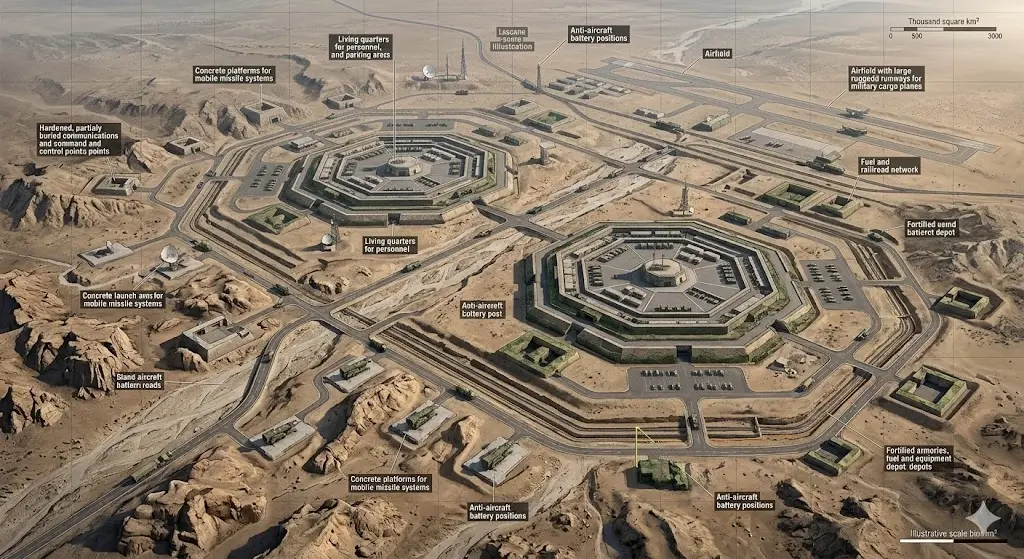
Imagine generată cu AI
China is developing a military complex in an isolated region in the country's north-west, a project security experts consider necessary for Beijing's ability to respond to a potential nuclear attack by the United States, Reuters reported. Satellite images analyzed by Reuters show a network of launch platforms, fortified bunkers, and communication infrastructure built near nuclear silo fields in the Xinjiang and Gansu regions. The facilities are intended to protect and operate China's land-based nuclear forces, analysts said.
Chinese nuclear missiles can already reach any city in the United States. The new constructions suggest Beijing is consolidating its infrastructure to ensure it can launch a counterattack even after a first strike on its nuclear arsenal. The images indicate over 80 launch platforms that could be used for mobile missile systems and anti-aircraft batteries.
Facilities that could serve for electronic warfare, satellite communications, and coordination of military operations have been identified. Alexander Neill, a security expert, said the project's scale indicates a significant consolidation and diversification of China's strategic nuclear deterrence system. "We see infrastructure built on a huge scale, which covers thousands of square kilometers of desert beyond the silo fields," Neill said.
China officially states it adheres to the "no first use of nuclear weapons" doctrine. Western diplomats and analysts assert that Beijing could use nuclear pressure to deter external intervention in a conflict over Taiwan. This month, Chinese leader Xi Jinping warned US President Donald Trump that Washington's handling of the Taiwan issue could lead to confrontation between the two powers.
Satellite images show two octagonal structures built in the last six years in eastern Xinjiang, southwest of the Hami nuclear complex. The structures include accommodation spaces for personnel and large military vehicles, protected by armored bunkers, fortified weapon depots, airfields, and railway connections to nuclear facilities. Military exercises have been observed around one of the bases recently, involving heavy equipment and camouflaged positions for mobile launchers.


Five security experts consulted by Reuters said the infrastructure appears primarily intended to support China's nuclear program, although some facilities could have other military uses. Key aspects remain unknown, including the exact types of weapons to be placed in these locations and whether the bases are prepared for mobile intercontinental ballistic missiles or mounting nuclear warheads. Hans Kristensen, an expert on nuclear armament, said the size of the infrastructure makes it difficult to exclude any scenario regarding the use of these facilities.
Analysts believe that some of the pipelines observed in images could house fiber optic cables for secure military communications. A facility near one of the main bases, believed to be for space communications, supports this theory, given the satellite antennas and towers identified in images. The scale of China's defensive system around its nuclear silos differentiates it from other major nuclear powers.
Unlike the United States and Russia, which rely on a large number of silos and their structural protection, China is developing an extensive anti-missile defense network around its facilities. "We haven't seen anything like this before," Kristensen said. Last September, China showcased several types of nuclear-capable armament, including mobile intercontinental ballistic missiles, at a military parade in Beijing.
US officials and arms control experts said Beijing is expanding its nuclear arsenal faster than any other state. The latest Pentagon report on the modernization of the Chinese military indicates that China could reach approximately 1,000 nuclear warheads by 2030. Beijing is developing an advanced early warning system based on Huoyan-1 satellites, capable of detecting the launch of an intercontinental ballistic missile in about 90 seconds and transmitting the alert to the command center within minutes.
The International Institute for Strategic Studies warned that a potential conflict between the United States and China over Taiwan could escalate to a nuclear level, signaling the world is on the brink of a new global nuclear arms race. The Asia-Pacific region is at the center of this strategic competition, raising concerns about the future of global security. As China continues to enhance its military capabilities, the international community watches closely, aware that the decisions made in these remote deserts could shape the geopolitical field for decades to come.
Comentarii
Fii primul care comentează.

Romania launches competency-based curriculum for 9th graders with digital textbooks

Ratcliffe warns Moscow against NATO provocation, presses for Ukraine deal

Retired General McCaffrey calls US military campaign against Iran 'strategic catastrophe'