Thirty years after a secret was first whispered, Potaissa carries Transylvania across the Prut
At the International Festival 'Dansul Vetrelor Nistrene' in Chișinău, the Potaissa ensemble from Turda performed over three hours of Transylvanian folklore. The festival marked the 30th anniversary of the Ciuleandra ensemble, unveiling a monographic book by Carolina Știrbu.
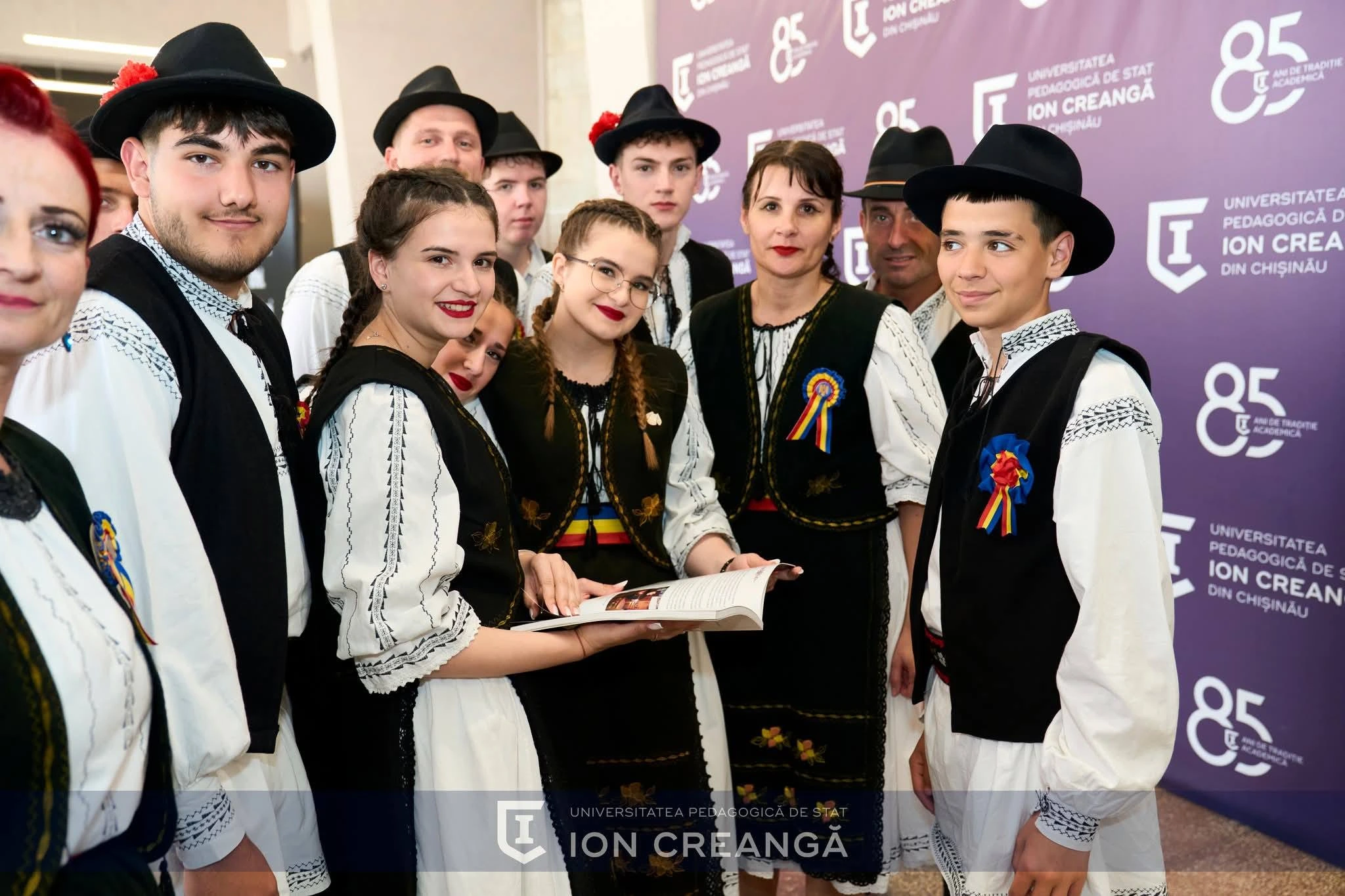
Imagine preluată Credit: Universitatea Pedagogică de Stat 'Ion Creangă'
The streetlights in Chișinău hold a particular quality in late spring, a soft glow that seems to suspend the city between what it was and what it is becoming, and on the evening when the fourth edition of the International Festival 'Dansul Vetrelor Nistrene' opened, that light fell across faces turned upward in anticipation, across the cobblestones still warm from the day, across the banners announcing that the 'Ciuleandra' ensemble was marking three decades of existence. Into this atmosphere, carried on an official invitation and the weight of their own repertoire, came the 'Potaissa' Folk Ensemble from Turda, thirty-five members strong, their presence a bridge flung across the Prut river, connecting the folklore of Transylvania to the heart of Moldova's capital. The festival has become, over its brief history, a fixture in the Moldovan cultural calendar, drawing performers and enthusiasts who understand that folklore is not merely performance but memory made visible, tradition given breath.
This year the event carried additional significance, celebrating the 'Ciuleandra' ensemble's thirty years of cultural contribution, and it was within this context that 'Potaissa' took the stage, their performance unfolding over more than three hours, a duration that speaks not to endurance but to the sheer depth of what Transylvanian folklore contains—dances that shift from the measured to the ecstatic, melodies that carry the inflections of Saxon villages and Hungarian plains, Romanian valleys and the particular hybrid culture that has made Transylvania what it is. Professor Ion Bencheci, from the 'Ion Creangă' State Pedagogical University in Chișinău, had orchestrated the program presented by 'Potaissa', his involvement lending the evening a scholarly dimension, the kind of academic rigor that transforms a performance into a document, a celebration into an archive. Bencheci's expertise in folk traditions has long made him a bridge figure himself, someone who understands that the dances and songs are not static artifacts but living practices, evolving even as they preserve something necessary about the communities that created them.
The festival served as well as the occasion for unveiling a monographic book titled 'Ciuleandra', created by Carolina Știrbu, a member of the ensemble whose name graces the cover. The book represents a thorough accounting of the ensemble's three-decade journey, and its launch was a moment of reflection, the kind of pause that allows a community to see itself clearly, to understand what has been built and what has been preserved. The dance 'Ciuleandra' itself, the namesake of the ensemble, is a lively and spirited form, its rhythms capturing something necessary about Romanian folklore—a certain defiance, a refusal to let joy be dimmed by circumstance.
Maria Popescu, a local resident whose enthusiasm for folklore has made her a familiar presence at such events, watched the 'Potaissa' performance with visible emotion. "It's incredible to see how our traditions are kept alive and celebrated," she said afterward, her voice carrying the particular satisfaction of someone who has watched these connections deepen over years. "The connection between our cultures is beautifully highlighted through such festivals."

Alexandru Ionescu, visiting from Romania, stood nearby, nodding. "Witnessing the dances and hearing the traditional music reminds me of home," he said. "It's a powerful reminder of our shared history."
What neither mentioned, though it hung in the air throughout the evening, was the secret that had been kept for thirty years, revealed only now as the 'Ciuleandra' ensemble marked its anniversary—a detail about the ensemble's founding that recontextualizes much of what came after, a piece of history that had been held close and was now being offered to the broader community. The nature of the secret was not dwelt upon in the formal proceedings, but its revelation added a layer of significance to the celebration, a sense that what was being honored was not just longevity but survival, not just tradition but the conscious choice to preserve it against considerable odds. For the 'Potaissa' ensemble, the festival represented an opportunity to share the particular character of Transylvanian folklore, a tradition woven from the region's layered history—Austro-Hungarian influences visible in the precision of certain dances, Romanian elements in the melodies, Saxon contributions in the costuming, all of it blended into something distinct.
From the post-1989 cultural renaissance to the present moment, Transylvania's folk traditions have evolved while retaining an identity that registers as both familiar and exotic to audiences in neighboring cultures, a quality that was evident in the Chișinău audience's response. The participation of 'Potaissa' at the festival underscored the importance of such exchanges in preserving folk traditions, the way that performance in a new context can revitalize what might otherwise calcify into mere routine. It served as a reminder of the cultural richness that persists in the region, evidence of music and dance's enduring power to connect communities across borders that are, in the end, more administrative than cultural.
As the festival concluded, the streets of Chișinău filled with the sounds of laughter and lingering music, conversations that would continue in cafés and homes, the kind of aftermath that marks a successful cultural event. For the locals, the festival was more than a series of performances—it was an affirmation of identity and heritage, a reminder of the history shared with neighbors across the Prut. For 'Potaissa', returning to Turda with the memory of three hours on a Chișinău stage, the journey represents another chapter in their ongoing work of carrying Transylvanian folklore beyond the mountains, their contribution to this year's festival a highlight that will be remembered as evidence of the enduring ties that unite the region, ties that are renewed each time the music begins and the dancers take their positions and the audience leans forward to watch.
Sursă: turdanews.net
Comentarii
Fii primul care comentează.