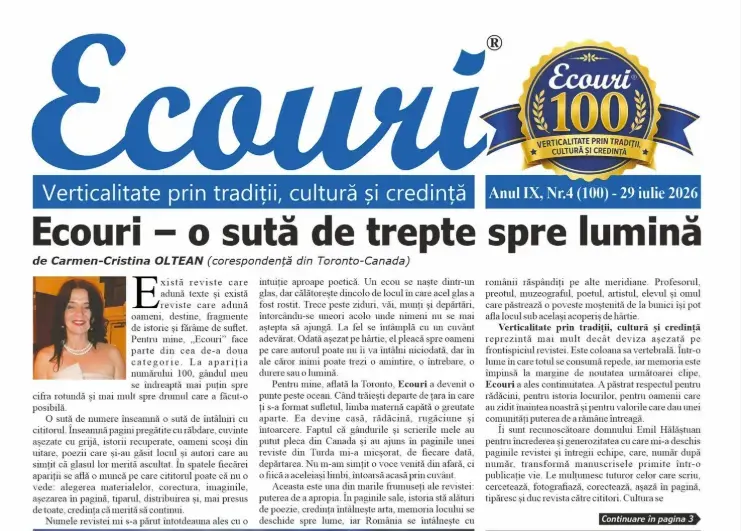
Ecouri reaches 100th issue, Turda's cultural archive endures
Ecouri, Turda's cultural magazine, reaches its 100th issue, highlighting its enduring role as a civic archive amid challenges facing regional press. The commemorative event includes speeches from local officials and honors past contributors, underscoring Ecouri's significance in preserving Turda's history and culture.

Imagine generată cu inteligență artificială
The magazine Ecouri publishes its hundredth issue this week. A commemorative almanac, Ecouri 100, will launch Wednesday, September 2nd, at 5:30 PM in the Grand Hall of Turda City Hall. The milestone arrives at a moment when regional cultural press survives more by stubborn will than by any structural support.
Editor-in-chief Emil Hălăștăuan founded the magazine and has kept it running as something closer to a civic repository than a conventional periodical. Ecouri has chronicled Turda's history, profiled local figures, and tracked the city's cultural shifts in detail that larger outlets ignore. The almanac, according to organizers, documents that work and stands as proof that such effort can persist.
The launch will open with a moment of silence for contributors who have died. Father Grigore Marchiș will offer a blessing. This choice of ceremony over spectacle reflects how seriously the organizers take both the magazine's past and its uncertain future.
Cristian Matei, Turda's mayor, and Ioan Roman, mayor of Viișoara, will speak. Their presence signals that Ecouri's influence extends beyond literary or academic circles. A publication focused on local culture does not typically command such official attention unless it has earned trust over decades.

Hălăștăuan will address attendees, situating the magazine's trajectory within Turda's broader evolution. His remarks are expected to cover the obstacles facing local publications, the editorial choices that have shaped Ecouri, and the precarious prospects for similar work ahead. The occasion compels a reckoning with what it costs to sustain a cultural institution in a city where such labor is rarely valued.
An exhibition of historical photographs from past Ecouri events will line the hall. The images offer a parallel narrative to the written record, anchoring the magazine's impact in faces and gatherings that might otherwise vanish. The exhibition highlight Ecouri's dual role as both chronicler and participant in Turda's cultural life.
Admission is free. Places will be allocated first-come, first-served. This openness aligns with Ecouri's longstanding ethos: the magazine has always imagined its audience as the city itself, not a narrow circle of initiates.
The centenary almanac, per the event program, documents Ecouri's chronicle of Turda's history, local figures, and cultural shifts. For one evening, the city's attention turns to the written word and the institutions that have kept its memory intact for a century.
Comentarii
Fii primul care comentează.