Turda's Devoted Trio: Serving the Public So Hard They Serve It Twice
USR Turda accuses councilors Nap, Irimie, and Budugan of a conflict of interest for holding dual public roles.
The three sat simultaneously on the Turda Municipal Council and the Administrative Board of Turda Municipal Hospital.
Romanian law — Law 161/2003 and OUG 57/2019 — explicitly prohibits this overlap for elected officials.
The National Integrity Agency holds authority to investigate, issue sanctions, and strip mandates if violations are confirmed.

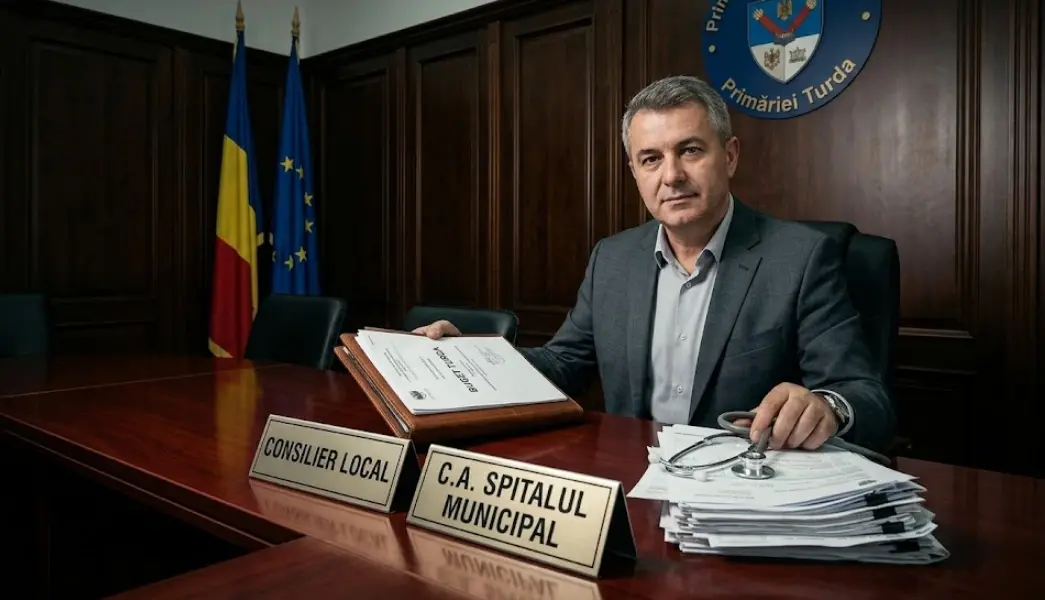
Imagine generată cu AI
There is a special breed of public servant — tireless, selfless, constitutionally incapable of holding fewer than two positions at once — and Turda, a town of modest size in Cluj County, has apparently produced three of them. Their names are Nap, Irimie, and Budugan, and they have achieved what lesser officials only dream of: a seat on the Turda Municipal Council and, simultaneously, a seat on the Administrative Board of the Turda Municipal Hospital. Two chairs, one posterior, infinite civic virtue. One can only marvel.
USR Turda, the local branch of the Save Romania Union party, has chosen not to marvel. Instead, the organisation has filed a formal accusation of conflict of interest, arguing that the three councilors have placed themselves in a position that Romanian law takes considerable pains to forbid. The allegation is not subtle: as members of the municipal council, Nap, Irimie, and Budugan participate in decisions about how public funds are allocated across the city. As members of the hospital's administrative board, they oversee how a portion of those same funds is managed within the hospital. The circle, USR Turda said, is rather too neat.
The legal architecture surrounding this kind of arrangement is not ambiguous, which is perhaps what makes the arrangement so architecturally bold. Law No. 161/2003, Romania's foundational statute on transparency and the prevention of corruption in the exercise of public functions, lays out with some precision what constitutes a conflict of interest for a public official. Government Emergency Ordinance No. 57/2019 — the Administrative Code — adds further specificity regarding elected local officials, their incompatibilities, and the circumstances under which their dual obligations become legally untenable. Neither text was drafted with the expectation that its readers would find creative workarounds. And yet.
The hospital board itself is not a ceremonial body. Under Law No. 95/2006 on healthcare reform, Romania's hospital administrative boards carry genuine authority: they approve institutional budgets, monitor management performance, and bear collective responsibility for the financial and operational direction of the hospital. Members of these boards are typically appointed by local councils — which is to say, in Turda, the council that includes Nap, Irimie, and Budugan may well have had a hand in placing Nap, Irimie, and Budugan on the very board those councilors now sit on. The ouroboros of Romanian administrative life swallows its own tail with practiced ease.


One might ask, charitably, whether the three councilors have simply been the victims of a scheduling accident — appointed in good faith, serving in good faith, perhaps even recusing themselves from votes where their dual roles created obvious tension. This is the defence that tends to surface in such cases, and it is not without a certain elegance. The appointments followed legal procedure, no objection was raised at the time, and the councilors' expertise in public administration surely benefits the institution. These are the kinds of arguments that sound reasonable in a press release and rather less reasonable when read alongside the statutes they are meant to address.
The National Integrity Agency — ANI, in the Romanian bureaucratic shorthand that has become as familiar to Romanian journalists as the smell of coffee — exists precisely for moments like this. ANI is the autonomous institution charged with verifying the wealth declarations, conflicts of interest, and incompatibilities of public officials across Romania. Its investigators are not required to take anyone's word for anything. If ANI opens a file on the Turda trio, the outcomes can range from a finding of incompatibility to administrative sanctions to, in the more dramatic scenarios, loss of mandate. ANI has walked this road before, many times, in many Romanian towns where the local talent for occupying multiple offices simultaneously has attracted institutional attention.
Turda is not, in this respect, an anomaly. The practice of appointing elected officials to the administrative boards of public institutions they are simultaneously supposed to oversee through the council budget is a recurring feature of Romanian local governance. Critics have long argued that it politicises hospital management, blurs the line between governance and oversight, and creates conditions in which the people responsible for allocating public money are also the people responsible for explaining why that money was spent as it was. Defenders of the practice argue that local expertise is scarce, that someone has to sit on these boards, and that the alternative — appointing people with no connection to local government — creates its own problems. Both positions contain truth. Neither resolves the legal question.
What USR Turda has done, by going public with the accusation, is force the question into the open. The three councilors now face not only the possibility of an ANI investigation but the more immediate discomfort of public scrutiny — a condition that tends to concentrate the mind wonderfully. Whether Nap, Irimie, and Budugan will choose to resign from one of their two roles, whether they will contest the allegation, or whether they will wait for an institutional process to run its course, remains to be seen.
In the meantime, Turda's municipal hospital continues to operate, its administrative board continues to meet, and the municipal council continues to deliberate. Somewhere in the overlap between those two rooms, three men sit with their agendas, their gavels, and their unusually full calendars, embodying a principle that Romanian public life has long struggled to extinguish: that the most reliable way to oversee public money is to be, personally, on both sides of the table.
Comentarii
Fii primul care comentează.