Political collapse in Bucharest: winners, losers, and the end of pretence
The fall of Adrian Veștea's cabinet marks the end of political consensus in Romania, with George Simion's AUR party forcing established leaders to seek his approval. President Nicușor Dan faces public humiliation, while traditional parties scramble for relevance. The spectacle highlights a dramatic shift in power and the decline of the ruling class's authority.

Romania's government has fallen. The real drama, though, played out elsewhere: in the humiliation of President Nicușor Dan, in the ruthless clarity of George Simion's political strategy, in the spectacle of a ruling class stripped of dignity and direction. The defeat of Adrian Veștea's cabinet left a trail of ruined careers, a handful of new power-brokers, and a single unmistakable message. The era of comfortable consensus is over.
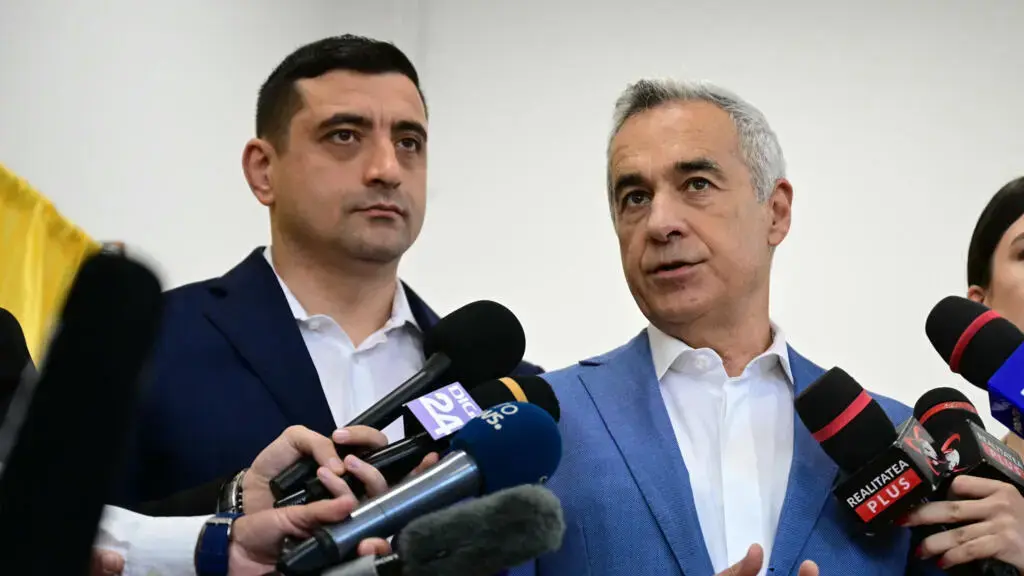
Simion, leader of AUR, forced the old parties to kneel. He did so not by negotiation, but by making them beg at his party headquarters. Veștea, the hapless nominee for prime minister, and Sorin Grindeanu, a party leader without a party, found themselves seeking Simion's approval as if it were the only currency left in Bucharest. The spectacle was not lost on the public. Nor was the fact that, in the validation hearings, ministers struggled to answer questions without resorting to AI-generated responses. A country that once prided itself on political finesse now witnessed its would-be leaders fumbling through parliamentary scrutiny like unprepared students.
The parliamentary vote itself was only the last act. Simion had already made clear his contempt for the established parties. He publicly rejected both PSD and "those traitors from PNL," calling out the sudden chorus of voices who insisted AUR was never extremist. Lucian Bode spoke first. Marian Neacșu followed. Each declaration marked another step in the capitulation of Romania's centrist establishment. The same individuals who, days earlier, denounced AUR as unfit for government now scrambled to reframe the party as a legitimate partner, all in pursuit of Simion's votes.
Within AUR, the tension was real. Reports pointed to Mohamad Murad, among others, already in private talks with PSD about backing Veștea's government. The outcome: AUR's entire parliamentary group left the chamber, isolating PSD and their new PNL allies. Simion would not be bought off with minor ministries or vague promises. The price of his support was open validation, concrete policies, and major portfolios. Demands the government's architects could not meet. The result: isolation for the ruling parties, unity for AUR.
The collapse of the Veștea government was not, in the end, a comment on its competence. No one in the chamber claimed Veștea was up to the job. But the decisive factor was AUR's refusal to legitimize an administration that offered them nothing but tokenism. The ministries had already been divvied up among the old guard. For Simion, acquiescence would have meant surrender.
President Nicușor Dan was left exposed. He vanished from the scene at the critical moment, leaving his allies to fend for themselves. The chain of errors was almost clinical in its predictability. Dan allowed the Bolojan government to fall, apparently believing it could be rebuilt without recourse to AUR. He assumed Ilie Bolojan would be removed from his party's leadership. When Bolojan survived, Dan tried to wrest control of PNL or to split it, despite the obvious depth of Bolojan's support. The final blunder: nominating figures with no ability to negotiate or inspire confidence.
This catalogue of mistakes invites three possible explanations, none flattering. Either Dan is simply out of his depth, or he is guided by personal animosities that cloud his judgment, or he is acting at the behest of interests far removed from the voters who sent him to Cotroceni. The effect is the same. The president's authority is broken, his reputation shredded. Those who once believed Dan might serve a second term now find themselves counting the days to his political exit.
A concession is due here. One could argue that the president's options were limited by the fragmentation of the political field and the volatility of party loyalties. Romania's parties have rarely presented a united front, and any leader would have struggled to manage the cross-currents unleashed by the fall of the old coalition. Yet the manner in which Dan lost every available support cannot be explained away by circumstance alone. From PNL to USR, from UDMR to the very voters who carried him to office, he alienated all sides. It took a particular brand of miscalculation to achieve such thoroughness.
Grindeanu, for his part, now faces his own reckoning. The party he tried to lead has already begun to turn on him. Paul Stănescu, an influential figure in PSD, wasted no time in attacking Grindeanu's leadership on the night of the government's defeat. The logic is as brutal as it is familiar: a party that loses power loses its leader. PSD's decision to table and support the motion against the government now looks like a strategic blunder. Power, for PSD, has always been the only guarantee of survival. Now, with the coalition broken and the opposition resurgent, the exodus begins. Mayors and parliamentarians, smelling the wind, prepare to defect to AUR.
Grindeanu himself made clear that he would not support a reformed coalition or endorse a minority government led by PNL, USR, and UDMR. The refusal leaves his party adrift, with no obvious path back to influence. The same dynamic applies to the so-called "putschists" in PNL, who now face expulsion from both the party and their public offices. Monica Anisie, Andrei Baciu, Sorin Cîmpeanu, Mihai Culeafă, Alina Gorghiu, Ion Iordache, Aneta Matei, Ciprian Pandea, Nicoleta Pauliuc, Alexandru Popa, Răzvan Prișcă, George Scarlat, Ionuț Stroe, Mihail Veștea, Sebastian Rusu, and Eduard Mititelu are, for all practical purposes, finished in politics. They have nowhere to go. PSD offers few safe seats, and the competition for those seats is already fierce.
Ilie Bolojan emerges as the day's other undisputed winner. He has installed new people at the top of PNL, broken the party's dependence on PSD, and secured his mandate through 2030. The party now stands at a crossroads. Bolojan has the chance to reform PNL fundamentally, to shape it as a modern party independent of old alliances. If he fails, the opportunity will vanish, and with it, the party's relevance. But for now, Bolojan is the man to watch. He is almost certain to run for president at the next election, and to gather around him a coalition broader than any in recent memory.
PNL, USR, and UDMR, though battered, emerge stronger for their refusal to capitulate. Their coordinated action, operating as if in a functional alliance, yielded tangible electoral benefits. Should early elections be called, these parties are poised to gain seats. The discipline shown in the face of the government's collapse stands in stark contrast to the opportunism of their rivals.
George Simion's performance deserves particular scrutiny. He played the crisis with surgical precision: refusing all overtures, constructing a message that resonated with his base, and consolidating AUR's position as kingmaker. Kelemen Hunor's remark that Simion "gave checkmate" was not hyperbole. Simion demonstrated that, in the new Parliament, power belongs to those who can say no, and mean it. He exposed the desperation of the old parties, forcing them to recant years of anti-AUR rhetoric in the hope of securing a few extra votes. The same reversal, repeated in public statements by Bode, Neacșu, and others, will haunt the centrist bloc for years.
The impact of these events will not be confined to party headquarters. Careers have ended overnight. Aspirations have been dashed. For some, the day's chaos marks the start of a new political journey; for others, the abrupt conclusion of decades in public life. The so-called "Experiment Veștea" has reordered the hierarchy of power in Romania. The era of backroom deals, of safe majorities and predictable outcomes, is over.
The contours of the new order are already visible. The collapse of the Veștea government has exposed the limits of presidential authority, the fragility of party loyalty, and the power of a single, determined actor to upend the system. For all the talk of five-dimensional chess, the outcome was as plain as the empty seats on the government benches. In Bucharest, power now belongs to those who understand that politics is not a game of words, but of nerve.
The verdict is simple: those who begged for power lost it, those who refused to compromise gained it, and those who mistook calculation for leadership have been left behind.
Comentarii
Fii primul care comentează.