Taiwan tests armed robot dogs for island defense
Taiwan is testing new autonomous defense systems, including machine gun-equipped robot dogs, to strengthen security on its islands amid ongoing tensions with China.

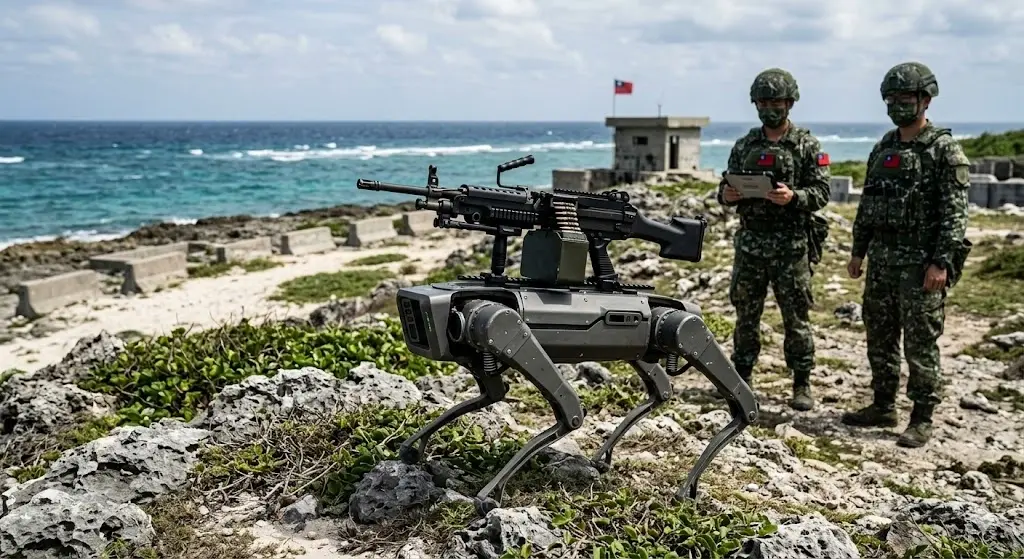
Taiwan has begun testing autonomous defense systems that include robot dogs equipped with machine guns. The machines can patrol, supervise, and open fire. The Chung-Shan National Institute of Science and Technology, Taiwan's main military research center, presented three models developed for reconnaissance, surveillance, and tactical support missions.
One carries a functional machine gun. The other versions focus on surveillance and intelligence gathering. Jen Kuo-kuang, Deputy Director of missile and armament research at Chung-Shan, said the military expressed interest in the platforms but has not placed an official order.
He said marines need systems for beaches, coastal areas, Nansha, and Dongsha. Taipei authorities are considering using the robot dogs on isolated islands. They are analyzing plans for coastal patrols, landing detection, and landing deterrence.
Taiwan controls the Pratas Islands and Itu Aba island. Both are difficult to defend with conventional forces. Military specialists have noted the vulnerability of the Pratas Islands to Chinese operations.
Taiwan is accelerating investments in autonomous technologies and unmanned systems as part of a broader effort to secure territories that sit exposed in contested waters. China claims Taiwan as part of its territory and does not exclude the use of force to bring the island under its control. Beijing's claims extend to the Pratas Islands and much of the South China Sea, a region marked by overlapping territorial disputes.
China has mobilized over 100 military and coast guard ships near Taiwan in recent operations. Although China has not directly targeted Itu Aba island with military action, the island remains within the scope of Beijing's broader territorial assertions. The robot dogs were developed by Ghost Robotics, an American company that supplies robotic systems to the US army.
The three variants represent different capabilities. The armed version is designed for direct engagement. The unarmed models are intended for observation and data collection in areas where human patrols are impractical or dangerous.
Taiwan's coast guard also sees the robotic systems as necessary for patrol and inspection missions. The machines offer a technological edge in securing maritime borders without exposing personnel to immediate risk. The democratically governed island has been expanding its defense posture in response to sustained pressure from Beijing.
The military has not yet decided whether to integrate the systems into its operational structure. Jen Kuo-kuang's comments suggest that interest exists at the command level, but procurement depends on further testing and evaluation. The marines, responsible for defending Taiwan's outlying islands, have been identified as the primary users if deployment proceeds.

The introduction of armed autonomous systems prompts questions about rules of engagement and the threshold for lethal force. Taiwan has not publicly detailed the protocols that would govern the robot dogs' use of weapons. The machines are capable of independent action, but it remains unclear whether human operators will retain final authority over firing decisions.
Taiwan's push into autonomous defense technology reflects a strategic calculation. The island's military is smaller than China's. Unmanned systems allow Taiwan to extend its defensive reach without a proportional increase in personnel.
The robot dogs are part of a wider trend that includes drones, automated naval vessels, and sensor networks designed to detect and respond to incursions. The Pratas Islands and Itu Aba island are particularly exposed. Pratas lies roughly 240 miles southwest of Taiwan's main island.
Itu Aba sits in the Spratly Islands, more than 900 miles south. Both are garrisoned, but reinforcement in a crisis would be difficult. Autonomous systems offer a way to maintain a defensive presence without committing large numbers of troops to isolated posts.
China's military activities near Taiwan have intensified. The mobilization of more than 100 ships represents a significant show of force. Taiwan's defense establishment has responded by prioritizing technologies that can operate in contested environments with minimal human oversight.
The robot dogs fit within that framework. Ghost Robotics has supplied similar systems to the US military, where they have been used for perimeter security and reconnaissance. The company's involvement in Taiwan's defense projects underscores the international dimension of the island's security strategy.
Taiwan has sought to use partnerships with the United States and other democracies to access advanced military technology. The next phase will depend on the military's assessment of the robot dogs' performance in field conditions. If the systems prove reliable, formal orders could follow.
The marines' interest suggests that deployment on outlying islands is the most likely scenario. Coastal patrols and landing deterrence are the missions Jen Kuo-kuang identified as priorities. Taiwan's investments in autonomous and unmanned systems are accelerating.
The robot dogs are one element of a broader effort to modernize the island's defenses. As tensions with China persist, Taiwan is betting that technology can offset numerical disadvantages and extend its ability to defend territories that remain vulnerable to Chinese pressure.
Source: adevarul.ro
Comentarii
Fii primul care comentează.