AUR's calculated reversal: Simion seeks recognition, not margins
AUR leader George Simion has withdrawn support for Adrian Veștea's government, citing a lack of meaningful engagement and demanding public recognition of AUR as a legitimate political actor. Simion challenges the persistent labeling of AUR as extremist and seeks clarity from other leaders about the party's role in the political process. This marks a calculated move for recognition rather than political marginalization.
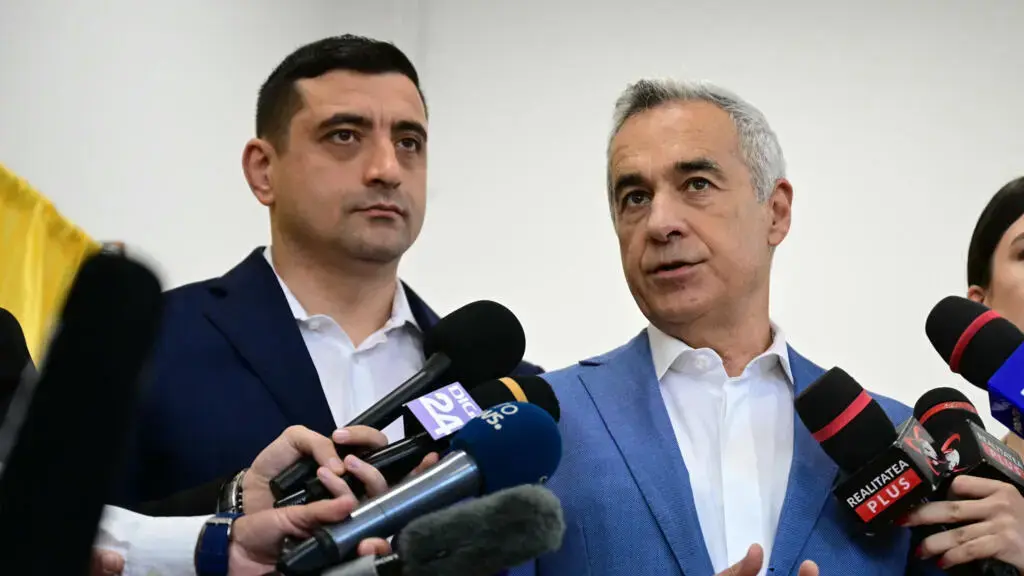
Arhivă
George Simion's unpredictability is not news. What has shifted is his demand for recognition, a seat at the table, not as a pariah but as a legitimate actor in Romanian politics. AUR's leader has withdrawn support for Adrian Veștea's government investiture, citing the absence of meaningful engagement from both Veștea and Nicușor Dan. This is not the first time Simion has changed course, but the rationale is clearer now than in previous episodes of brinkmanship.
Simion's own words make the pivot explicit. He announced that AUR's parliamentarians would not vote for the Veștea government, highlighting that the premier-designate had not sought their support. "We, indeed, are a patriotic party and can show patriotism, but arguments must be brought to us," Simion told reporters. The implication: AUR is not interested in playing the role of a useful idiot, supplying votes while remaining branded as extremists by the rest of the political spectrum.
The context here is not trivial. For months, AUR has been the subject of routine denunciation by President Klaus Iohannis and by every parliamentary party, with the label "extremist" attached in nearly every public reference. Simion's rhetorical question, "Are we still extremists, since our votes are so hunted?", is less self-pity than a pointed indictment of the transactional hypocrisy at play. He demands that both Veștea and Dan publicly clarify whether AUR's support is acceptable, or whether the party remains untouchable.
Without AUR, Veștea faces a narrow path to a majority. Simion's maneuver is timed to extract concessions, not only in policy but in the narrative: he wants PSD and Dan to acknowledge AUR as a legitimate political force. This is a higher ask than it may first appear, given the party's recent history.
Simion's list of grievances is long. He claims that AUR has been right all along, that their positions, once derided, are now being vindicated by events. The party, he insists, remains "faithful to the Romanian people," and is "coherent" and "consistent" in its opposition, both parliamentary and political, since December 2025. The priorities, as Simion repeats, are early elections and, if the current exclusionary style continues, the suspension of Dan. This is not just about government formation. It is about resetting the rules of engagement in Bucharest.
In the same breath, Simion says AUR is willing to act transparently "to get Romania out of crisis" and to remove "harmful persons and actions" that have led the country to the brink. He stops short of naming those responsible, but the implication is obvious: the established parties, now scrambling for votes, are the authors of the current instability.
Simion goes further. He alleges that his colleagues have been approached by figures from various parties, seeking to buy their votes with promises of advantage. This charge, vote-buying in effect, has not been substantiated with names or evidence. Still, it is a familiar trope in Romanian politics, and Simion knows how to wield it for effect.
If the vote is held tonight, Simion says, AUR's response will be to leave the chamber. He calls on Veștea to surrender his mandate or postpone the vote, warning that a majority is out of reach. "At 20:00, we await him at the party headquarters," Simion announced. The invitation is both taunt and test: will the premier-designate engage, or will he risk defeat?
Simion frames his message as one of national reconciliation. He says AUR is ready to help, now that the "extremist" label has, in his view, been discarded. The decision, he maintains, depends on discussions with Veștea and Dan. Transparency, he promises, will follow.
There is an overt ambition here. "We would be glad to have an AUR nomination," Simion says, adding that the party is ready to assume governance, a responsibility, he notes, that "many are fleeing from." This is not the language of a party content with marginal protest. It is the language of a contender seeking entry into the mainstream.
Simion also targets Ilie Bolojan and his team, arguing that they should not remain in government after being removed by a motion of censure. "I ask Ilie Bolojan to leave Victoria Palace," Simion declared. The demand is as much about drawing lines as about policy; AUR positions itself as both outsider and prospective alternative.
The opposing argument deserves attention. AUR's reputation, built on nationalist rhetoric and confrontational tactics, has made it toxic for many in the political establishment. President Iohannis, along with PSD, PNL, and USR, have all repeatedly described AUR as extremist. The concern, voiced by these parties, is that legitimizing AUR would erode democratic norms and embolden radical actors. To their credit, this is not a purely rhetorical position; it is grounded in AUR's own record of inflammatory statements and disruptive conduct in parliament.
Yet the current situation exposes a contradiction. If AUR is truly beyond the pale, why do the same parties seek its votes in moments of crisis? Simion's challenge is not only to Veștea and Dan but to the entire system: define the boundaries, or admit that pragmatism trumps principle when majorities are at stake.
The calculus for PSD and Dan is unenviable. To engage with AUR risks normalizing a force many of their voters find unacceptable. To exclude AUR, though, may mean legislative deadlock or, worse, a government that cannot command a majority. Every vote counts, and so every party becomes, at least temporarily, a potential partner.
For Simion, the moment is an opportunity to recast AUR's image. He wants to move the party from the status of "useful idiot" to indispensable actor. The insistence on a public meeting with Veștea and Dan is more than a negotiating tactic; it is a demand for public rehabilitation. Whether this gambit will succeed depends less on AUR's consistency (Simion's reversals are well-documented) than on the desperation of those seeking power.
The charge that AUR's votes are being hunted while its members are still branded extremists has some merit. It is not the first time in Romanian politics that parties publicly denounce each other while cutting deals behind closed doors. What is unusual is Simion's insistence on making the contradiction explicit, and on demanding a public reckoning.
To be clear, the risk of normalizing AUR remains real. The party's record cannot be erased by a single round of negotiations. Yet the alternative, perpetual instability, endless ad hoc alliances, brings its own dangers. If the political system cannot decide who is in and who is out, the rules become malleable, and trust in institutions erodes further.
For the electorate, the consequences are immediate. AUR's supporters will see in Simion's stance a validation of their grievances, a sign that the party is finally being taken seriously. Opponents will see a dangerous flirtation with the extreme. For PSD and Dan, the cost of engagement is reputational; the cost of exclusion may be legislative paralysis.
Simion has made his move. The rest of the political class must now show their cards. Romanian democracy will be measured less by who holds power than by who gets to belong.
Comentarii
Fii primul care comentează.