Iceland concedes 87th-minute goal after violating FIFA's new 10-second substitution protocol
Japan won 1-0 against Iceland in a friendly match testing new FIFA rules slated for the 2026 World Cup. The match highlighted the potential impact of these regulations on game dynamics.

Credit: Shutterstock
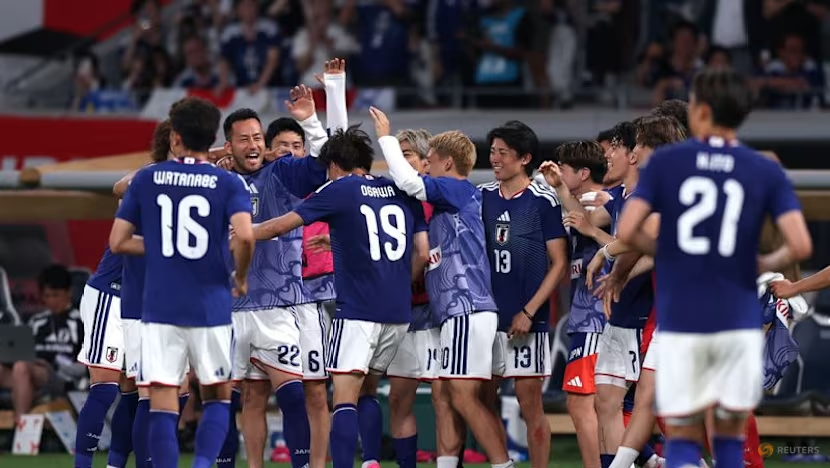
Japan defeated Iceland 1-0 in a friendly match that doubled as a live test of regulatory changes FIFA will enforce at the 2026 World Cup. The match, played under experimental conditions, ended with a goal in the 87th minute by Koki Ogawa—a goal made possible not by tactical brilliance but by Iceland's failure to comply with a new substitution timing rule. The rule in question is straightforward: a substituted player must leave the field within 10 seconds.
Exceed that window, and the team plays with 10 players for one minute while the incoming substitute waits on the sideline. In the 85th minute, Iceland attempted a double substitution. Ísak Bergmann Jóhannesson Hlynsson did not exit within the allotted time.
His replacement, Thorvaldsson, was forced to wait. Iceland played a man down. Japan, recognizing the numerical advantage, launched a positional attack.
Ogawa finished with a header. The sequence was reported by Total Football on May 31, 2026, and it crystallized the tactical consequences of what might otherwise seem like a minor procedural infraction. A 10-second delay translated directly into a match-deciding goal.
The substitution rule is part of a broader package of changes FIFA is testing ahead of the 2026 World Cup, which will be co-hosted by Canada, Mexico, and the United States. The tournament will feature 48 teams for the first time, and FIFA has framed these regulatory adjustments as necessary to maintain pace and reduce time-wasting in a format that will produce significantly more matches. Another new rule imposes a five-second limit on restarts from throw-ins and goal kicks.
Exceed that window, and possession is turned over. The intent is clear: eliminate the dead time that accumulates when players dawdle over set pieces. Whether five seconds is the correct threshold remains to be seen, but the rule reflects FIFA's preference for enforcing tempo through sanction rather than relying on referee discretion.
The Japan-Iceland match also tested a rule governing off-field medical assistance. Players who receive on-field treatment must now leave the field and wait one minute before re-entering, unless the injury resulted from a foul that warranted a card. The rule is designed to discourage simulation and ensure that only genuinely injured players receive on-field attention.
It shifts the burden of proof: if you go down, you come off. Referee interaction has also been formalized. Only team captains are now permitted to approach referees.
Other players who attempt to pressure or dissent risk a yellow card. The rule is not new in spirit—referees have long tried to manage player conduct—but it is now codified and, presumably, will be enforced with greater consistency. Video Assistant Referee technology has been expanded.
VAR can now review second yellow cards that lead to expulsions and incorrect corner kick awards. The expansion addresses two areas where officiating errors have historically been difficult to correct in real time. Second yellows, in particular, have been a gray area: VAR could review straight reds but not the accumulation of cautions.


That gap is now closed. The Japan-Iceland match was a friendly, and friendlies are often treated as low-stakes affairs. But this one carried procedural weight.
It was a live test of rules that will govern the World Cup, and it exposed how quickly a team can be penalized for failing to internalize new protocols. Iceland's coaching staff will have noted the sequence. Ten seconds is not much time, especially during a double substitution when communication and coordination are already stretched.
For Japan, the match was both a victory and a proof of concept. The Samurai Blue are known for disciplined execution, and they capitalized on Iceland's lapse without hesitation. The goal itself was unremarkable—a header from a positional attack—but the context was not.
Japan demonstrated that under the new rules, awareness of procedural timing can be as important as tactical positioning. Iceland, by contrast, will need to adapt quickly. The team has built its identity on spirited, organized play, but organization under the new rules requires a different kind of precision.
Substitutions must be rehearsed. Restarts must be instantaneous. Medical stoppages must be managed with an eye toward the one-minute re-entry clock.
These are not dramatic shifts, but they are shifts nonetheless, and they will require adjustment. The 2026 World Cup will be the largest in history, and FIFA has made clear that it intends to manage the expanded format with tighter procedural controls. The new rules are not about changing the nature of the game; they are about enforcing a faster version of it.
Whether that serves the sport or simply creates new opportunities for procedural errors is a question that will be answered over the course of the tournament. For now, the Japan-Iceland match offers a preview. A 10-second delay cost Iceland a goal.
A five-second restart rule will cost other teams possession. A one-minute medical absence will force substitutions that coaches did not plan for. These are the new parameters, and teams that fail to adapt will pay for it.
The countdown to the World Cup is underway. The rules are set. The testing phase is over.
What remains is execution, and as Iceland learned, execution under the new regime requires a stopwatch as much as a playbook.
Sursă: www.gsp.ro
Comentarii
Fii primul care comentează.