Bucharest market rout delivers verdict on political failure
The sharp downturn on the Bucharest Stock Exchange signals a strong market reaction to Romania's ongoing political instability and populism. While most Romanians remain detached from the stock market, this disconnect amplifies the consequences of political mismanagement. The event highlights how investor sentiment, much like betting markets, can swiftly shift in response to uncertainty.

Imagine generată cu inteligență artificială
Yesterday's collapse on the Bucharest Stock Exchange was no technical correction. The market delivered a blunt verdict on Romania's political class: instability and populism come with a bill, and this time domestic capital paid it in full view of a largely indifferent public. For most Romanians, the stock exchange remains an abstract concept, its screens and indices as distant as the jargon-laden world of Polymarket or Betano is familiar. That detachment is itself a symptom. When few have the means or motive to care, the consequences of political mismanagement are both more severe and less likely to provoke real change.
The similarities between the betting shop and the stock market are not accidental. Both arenas revolve around risk, information, and sentiment. At Betano, every player weighs public data and private hunches, deciding how much to stake today for a possible return tomorrow. On the Bucharest Stock Exchange, the process is dressed in the language of valuation and discounted cash flows, but the logic is the same: investors process news, filter it through their own risk appetite, and arrive at a price they are willing to pay. The result in both cases is a number that reflects the crowd's collective mood about what the future holds.
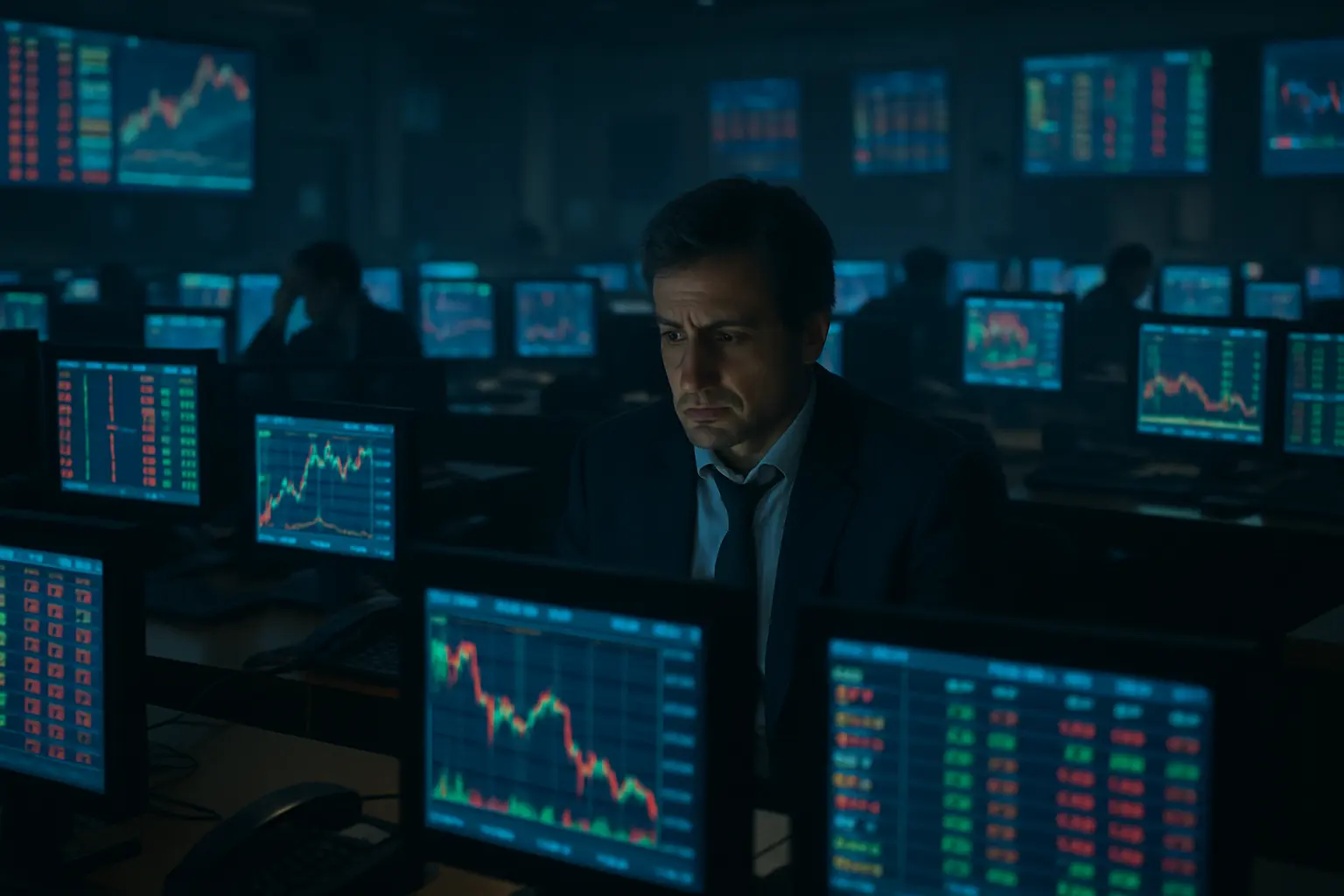
What happened on 31 August 2026 was a case study in how those moods can turn. By 16:15, the trading screens were a sea of red. The BET index's titans fell in lockstep, line after line, as panic and distrust overwhelmed any rational consideration of value. S.N.G.N. Romgaz led the rout, plunging 5.33 percent to 17.76 lei, according to closing data. Transport Trade Services followed, down 5.31 percent, battered by ongoing infrastructure bottlenecks. BRD, Groupe Societe Generale, a bellwether for the banking sector, lost 4.2 percent, closing at 34.20 lei.
MedLife and Banca Transilvania, the latter being the country's largest lender, shed 3.95 and 3.73 percent respectively. Banca Transilvania witnessed a wave of capital flight unprecedented since the pandemic years. Energy stocks were not spared: Electrica dropped 2.84 percent, Transelectrica 2.25 percent, OMV Petrom 2.2 percent. These are not minor corrections. This was a broad-based liquidation of Romanian assets, managed by the day's top brokers, TradeVille and BT Capital Partners, at volumes that rule out any theory of a mere technical adjustment.
The strongest counterargument, voiced by some defenders of the current government, is that markets are prone to overreaction and that foreign funds can be fickle. They point to past episodes, Brexit, the Greek crisis, when panic selling was later reversed as fundamentals reasserted themselves. The claim is that Romania's underlying economic strengths, from its EU membership to its relatively low debt-to-GDP ratio, will ultimately put a floor under valuations. That is plausible, as far as it goes.
Yet the evidence from this selloff suggests something deeper is at work. The political backdrop is impossible to ignore. The blame does not rest with a single party or institution. On one flank stands the PSD-AUR alliance, whose populist and nationalist rhetoric has, according to market participants, systematically undermined macroeconomic stability. Through legislative blockades and performative sovereignty, this coalition has sent repeated signals that rules and commitments are negotiable, especially when electoral advantage is at stake.
On the other, at the apex of the state, sits President Nicușor Dan, who has styled himself "the president of the system." In practice, the system he presides over has proven incapable of meeting critical European deadlines, most notably on the Single Wage Law. The cost is measurable. Chronic deadlock over wage reform resulted in the permanent loss of €770 million from the National Recovery and Resilience Plan, according to official PNRR monitoring reports. That sum, money earmarked for major investments and for the very companies now bleeding value on the stock exchange, was lost not to market forces, but to bureaucratic inertia and political infighting.
The signal to foreign investment funds and the managers of the second pillar pension system was clear: Bucharest offers no reliable counterparties, only caretakers of a failing state apparatus. The events of this week are only the latest in a series of warnings. Independent financial analysts have described Romania's fiscal position as "dramatic." Even within government circles, there is open acknowledgment that the state cannot afford to lose billions more. The lesson, for those willing to see it, is that investors do not wait for collapse to become certain. They sell at the first sign that no one is minding the store.
It is tempting, especially for those insulated from the market's daily swings, to dismiss the selloff as an overreaction. Yet such a view misreads the function of capital markets. The stock exchange is not a casino, despite superficial similarities to the betting shop. It is a pricing mechanism for risk, a barometer of the country's economic weather. When the screens go red, it is not only the traders who lose: companies see their cost of capital rise, the state's borrowing costs climb, and, eventually, the effects ripple outward to employment and public services.
The reflex of Romanian politics has long been to treat the capital market as someone else's problem. With participation rates among the lowest in the EU, and with the average citizen's savings insufficient to contemplate share ownership, the temptation to ignore the market's signals is strong. But the consequences are not so easily contained. As the experience of the last decade in Hungary, Turkey, or even Poland shows, when capital flees, it does not return on command. The downgrading of a country's credit rating, inevitable if deficits remain unchecked, brings higher interest rates, currency volatility, and, in the end, higher taxes and lower real incomes.
No party emerges from this episode unscathed. The ruling coalition's failure to deliver on basic reforms, the president's preference for institutional theater over consensus-building, and the opposition's embrace of easy answers have all contributed to the current impasse. The market's response was not to a single law or speech, but to the cumulative effect of years of short-termism and denial.
There remains a narrow path out. The precedent exists: in 2013, after a similar bout of market turbulence, a cross-party agreement on fiscal rules and EU compliance helped restore stability. But that required political actors willing to subordinate their ambitions to the country's long-term interests. Today, with elections looming and populist incentives at a premium, such leadership is in short supply.
The parallel to betting remains instructive. At the bookmaker, the odds can shift suddenly, but the house never loses sight of the math. On the stock exchange, the numbers are less forgiving. Yesterday's bloodbath was not an act of God or the result of foreign conspiracy. It was the market's instant audit of a system that has stopped pretending to care about credibility or discipline. The losers are not just the institutional investors or the pension funds. The real cost will be paid by those whose jobs depend on investment, whose pensions are tied to market performance, and whose public services rely on cheap state financing.
If there is a lesson in this rout, it is that the market's judgment cannot be deferred or ignored. The numbers on the screen do not negotiate.
Comentarii
Fii primul care comentează.