AUR deputy posts map showing Ukraine partitioned, Romania occupying Bukovina
Romanian deputy Ciprian Ciubuc posts a map dividing Ukraine into four parts. Ciubuc suggests Romania would occupy Ukrainian Bukovina.
Claims Russia will take half of Ukraine and remains a major nuclear power. Ciubuc's statements raise concerns over disregarding international treaties.
AUR party's potential governance could lead to conflict with Ukraine.

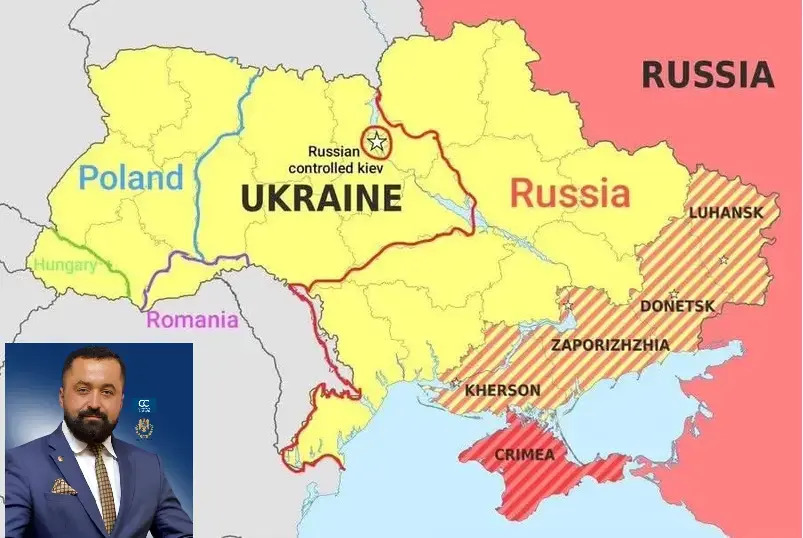
Imagine preluată pagina de Facebook a deputatului AUR Ciprian Ciubuc (colț dreapta), în care România anexează o parte din teritoriul ucrainian.
Ciprian Ciubuc, a deputy from the Alliance for the Union of Romanians (AUR), posted a map on social media today depicting Ukraine divided into four parts, with Romania occupying Ukrainian Bukovina. The map, shared on Ciubuc's account, shows territorial divisions that contradict existing international borders and the post-1991 European settlement.
In the accompanying text, Ciubuc claimed that Ukraine no longer receives aid and that Russia, as a major nuclear power, will take half of Ukraine. He wrote that the map represents a likely future configuration of the region. "Chiar dacă unora nu le place această perspectivă, eu cred că în câțiva ani harta regiunii va arăta foarte asemănător cu ceea ce vedem astăzi în această proiecție. Cei care nu sunt de acord pot salva această hartă și o pot compara peste timp," Ciubuc said in the post.
The deputy, who sits in Romania's Chamber of Deputies as a member of the nationalist AUR party, argued that Russia's historical presence in the region makes direct conflict between major nuclear powers unlikely. "Rusia rămâne o putere nucleară majoră, iar istoria ne arată că am avut-o în coaste de sute de ani, a fost un actor important în regiune timp de secole. Din acest motiv, consider puțin probabil un conflict direct între marile puteri nucleare," he said.
Ciubuc also addressed NATO's role in Eastern Europe, suggesting that the alliance would become ineffective without United States participation. "De asemenea, cred că rolul SUA este esențial pentru capacitatea de descurajare a NATO în Europa de Est, Totuși dacă SUA se retrage din NATO, această organizație va fi ca și inexistentă în raport cu organizația BRICS," he said in the post.
The map and accompanying statements appear in a post that also included incomplete text beginning with "În opinia mea, există semne că sprijinul pentru Volodimir Zelenski preș" — the sentence cuts off mid-word, suggesting either a technical error or an unfinished draft published inadvertently.
Bukovina, the region Ciubuc's map assigns to Romania, has been part of Ukraine since 1991, when the Soviet Union dissolved. Northern Bukovina was annexed by the Soviet Union in 1940 under the Molotov-Ribbentrop Pact, briefly reclaimed by Romania during World War II, then reincorporated into Soviet Ukraine in 1944. Romania recognized Ukraine's borders, including Northern Bukovina, in the 1997 Treaty of Good Neighbourship and Cooperation, ratified by the Romanian Parliament.
The AUR party, founded in 2019, holds 47 seats in the 330-member Chamber of Deputies and 14 seats in the 136-member Senate, per results from the 2020 parliamentary elections. The party has campaigned on nationalist themes, including opposition to COVID-19 restrictions, skepticism of European Union policy, and calls for reunification with the Republic of Moldova. AUR has not issued a statement on Ciubuc's post as of this writing.
Ciubuc's post comes as Ukraine continues to defend its territory against Russian forces, which launched a full-scale invasion in February 2022. Western governments, including Romania's, have provided military and financial aid to Ukraine under the framework of bilateral agreements and European Union coordination. Romania, which shares a 649-kilometer border with Ukraine, has served as a logistics hub for aid delivery and has accepted more than 100,000 Ukrainian refugees since the invasion began, according to data from the United Nations High Commissioner for Refugees.
The deputy's claim that Ukraine no longer receives aid contradicts publicly available information. The European Union approved a €50 billion aid package for Ukraine in February 2024, per a decision by the European Council. The United States Congress authorized $61 billion in military and economic assistance in April 2024, according to the U.S. Department of Defense. Individual European governments, including Germany, the United Kingdom, and Poland, have announced additional bilateral commitments totaling tens of billions of euros through 2025.
Ciubuc's reference to BRICS — the economic grouping of Brazil, Russia, India, China, and South Africa, expanded in 2024 to include Egypt, Ethiopia, Iran, and the United Arab Emirates — positions the organization as a counterweight to NATO. BRICS has no military alliance structure comparable to NATO's Article 5 collective defense commitment. The organization focuses on economic coordination, development finance, and trade in national currencies, per its founding documents and summit declarations.
The post has drawn attention on Romanian social media, with several political commentators and opposition figures criticizing Ciubuc's statements. No formal response has been issued by the Romanian Ministry of Foreign Affairs or by Ukraine's embassy in Bucharest. AUR's leadership has not commented on whether Ciubuc's map represents party policy or his personal view.
Ciubuc did not respond to questions about the source of the map or whether he consulted with party leadership before posting it. The deputy's social media account remains active, and the post in question had not been deleted as of late afternoon today.
Comentarii
Fii primul care comentează.