Romanian humor and the limits of artificial intelligence
During a panel at the TIFF Lounge, Mircea Bravo, Ioana Luiza, and Corneliu Porumboiu explored if artificial intelligence could ever understand Romanian humor. They discussed how humor acts as a shield against adversity and why the nuanced, character-driven jokes of Romania remain resistant to machine interpretation. The conversation highlighted the deep cultural roots and resilience embedded in Romanian comedic traditions.

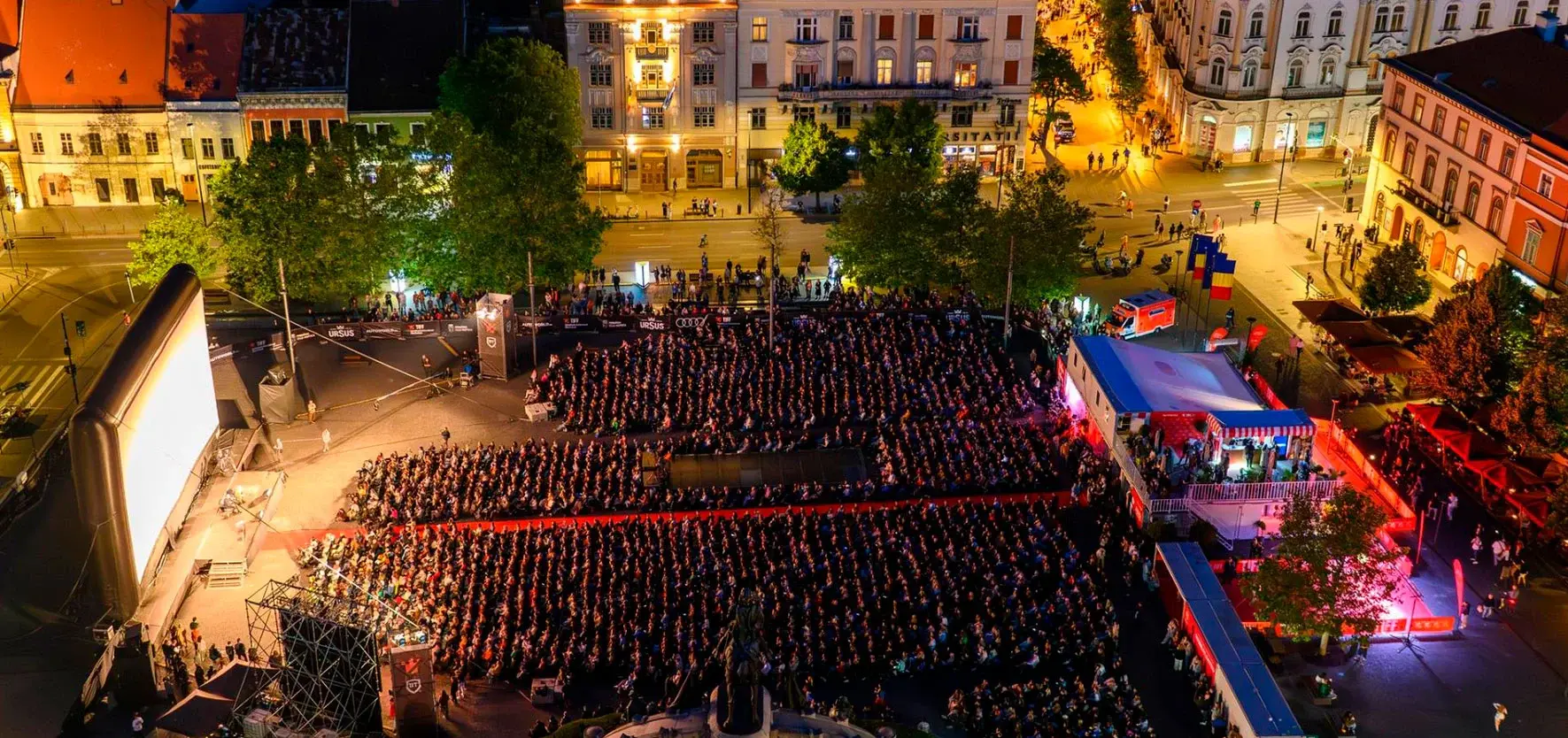
Three figures sat on stage at the TIFF Lounge in Cluj on June 18, 2026, to discuss a question that has no easy answer: whether a machine could ever understand the jokes that animate a Romanian kitchen table. Mircea Bravo, whose sketches circulate widely on social media; Ioana Luiza, a stand-up comic whose monologues dissect daily hardship; and Corneliu Porumboiu, twice winner of the Transilvania Trophy, joined moderator Mihnea Măruță for a conversation titled Cascadorii râsului. The premise was narrow but revealing. What keeps the Romanian sense of humor so resistant to artificial intelligence, and why does the old haz de necaz, the ability to laugh through misfortune, persist as a national trait?
Bravo's position was unambiguous. Humor operates as a shield against pain. Romanians will joke about anything, even catastrophe; should the world end tomorrow, he said, the impulse would be to see who can tell the best joke before the lights go out. This refusal to surrender to despair, and the insistence on finding the comic angle even at the edge of disaster, is a form of resilience. Yet Bravo also drew a distinction between comedy rooted in character and the generic, formulaic kind. The audience is quick to recognize when a joke is poorly executed. Cringe is the inevitable result.
Porumboiu, whose films A fost sau n-a fost? (2006) and Polițist, adjectiv (2009) have earned acclaim in Romania and the United States, compared the Romanian comedic sensibility to that of Ireland. Both nations, he argued, thrive on the absurdity of everyday situations. The success of his films abroad, particularly in the US, he attributed to this shared taste for situational irony. A director sets the terms of engagement early, Porumboiu continued. In the first fifteen minutes, the film's conventions are established; after that, the viewer knows what kind of world they have entered. This framing is necessary, especially when dealing with humor that risks alienating or offending.
Luiza approached the subject from the ground level of lived experience. The pleasure of stories lies in comparison: people take comfort when their own hardship seems lighter than someone else's. Haz de necaz, far from being a sign of cynicism, is a coping mechanism tailored to a society where adversity is common currency. Black humor will always find fertile ground in poorer countries, she added, an observation not meant as a slight, but as a recognition of how economic realities shape what people find funny. As for artificial intelligence, Luiza was direct. AI is not funny. It lacks a soul, she told the audience, and the jokes it produces are "extraordinarily cringeworthy." Without the ballast of real experience and emotion, the machine cannot generate genuine comedy.
Bravo expressed the hope that AI would not surpass human comedians in the next five or six years. There is something irreplaceable about the transmission of a joke, he argued: the inflection, the energy, the sense of timing that only a person can provide. In his view, human stand-up will become a premium product, a luxury compared to the flat affect of a robot's punchline. Porumboiu, less alarmed by technological advance, saw a different utility for AI. As a research assistant, perhaps, but not as a source of creative writing.
The conversation circled back repeatedly to the risks and responsibilities of black humor. All participants agreed that when a comedian addresses sensitive topics, context is everything. The performer must draw clear boundaries, letting the audience know the rules. Luiza emphasized that black humor demands precision in formulation, as well as a receptive audience capable of understanding the underlying intent. Capture attention quickly, she advised; the first seconds of a social media clip determine whether viewers stay or scroll away.
Underpinning these arguments was a consensus that humor is social glue. Laughter nourishes friendships and forges personal connections. The kinds of jokes that resonate most are not universal. Traditions and regions shape comedic preferences, and every country develops its own palate for what is funny and what is off-limits.


Porumboiu's analogy to Irish humor is not merely decorative. Both cultures have histories marked by hardship: occupation, economic struggle, migration. This may explain the affinity for the absurd and the self-deprecating. His films often depict the futility of bureaucracy or the anticlimax of revolutionary moments, relying on the viewer's recognition of a shared predicament. The laughter that emerges is tinged with melancholy, but it is also a form of defiance.
Bravo's sketches draw their power from recognizable types. The officious bureaucrat, the overbearing parent, the neighbor who always knows better. He crafts these characters with enough specificity that the humor feels local, but not so narrowly that outsiders are excluded. The formula, if there is one, is to begin with what everyone knows and then push the scenario just past the plausible. When this balance is lost, Bravo warned, embarrassment replaces laughter.
Luiza's stand-up is built on confession and comparison. Her routines invite the audience to measure their own anxieties against hers, and in doing so, to find relief. The pleasure, as she described it, is in the realization that someone else's troubles can be worse. A dynamic that may seem perverse, but which is familiar to anyone who has ever laughed at a friend's misfortune (with their consent, of course).
The specter of artificial intelligence haunts all creative domains, but comedy appears especially resistant. The panelists agreed that AI-generated jokes, stripped of context and delivered without affect, fall flat. There is a mechanical quality to the humor produced by algorithms, an absence of risk and surprise. Even when an AI system can mimic the structure of a joke, it cannot supply the lived experience, the pain, or the timing that make a punchline land. Bravo's prediction that human comedy will become a luxury good is not without irony. In a world saturated by content, the scarcity of genuine connection is what will command a premium.
Social media has altered the terms of comedic engagement. Luiza's observation about the importance of the first few seconds is borne out by the metrics: if a video does not seize attention immediately, it is lost in the scroll. This demand for instant gratification puts pressure on comedians to sharpen their material, but it also risks flattening the complexity that makes humor endure. Porumboiu's films, by contrast, ask for patience; they reward viewers who are willing to sit through awkward silences and slow reveals.
Tradition and region play decisive roles. The kinds of jokes that work in Maramureș may fall flat in Constanța, and Romanian audiences, like their Irish counterparts, are quick to detect inauthenticity. Attempts to export humor wholesale, whether through translation or algorithm, often founder on these differences.
The panelists at TIFF Lounge did not offer a formula for comedic success, nor did they proclaim the death of human humor at the hands of AI. What they described, rather, was a set of conditions that define Romanian humor: the necessity of lived experience, the importance of context, and the irreducibility of personal connection. These elements—rooted in resilience, character, and the ability to find meaning in hardship—form the bedrock of a humor that resists algorithmic replication.
Comentarii
Fii primul care comentează.